
NFPA 660 and Your Garage Shop: What the New Dust Standard Requires (and What It Doesn't)
NFPA 660 and Your Garage Shop: What the New Dust Standard Requires (and What It Doesn't) - A step into the workshop.
Stop Wasting Wood
Generate clear cut diagrams instantly with our new Cutlist Optimizer. Plan your cuts to make your next build easier.
The question showed up in my inbox twice in one week, which is how I know a topic has legs: does the new NFPA dust standard apply to my garage shop? Both writers had seen headlines about NFPA 660, the consolidated combustible dust standard that took effect in December 2024, and both had the same look in their eye. Not fear, exactly. That particular uncertainty of a hobbyist who suspects that somewhere out there, a rulebook has grown another chapter with their name on it.
So let's do what I do with any spec or standard that crosses my bench: read the scope, trace the enforcement, and figure out what actually applies to you versus what's just good practice you can borrow for free. The short answer is that almost none of NFPA 660 is legally binding on a homeowner. The longer answer is more interesting, because the parts that aren't binding are still the best engineering guidance available anywhere on wood dust.
What NFPA 660 Actually Is
NFPA 660, the Standard for Combustible Dusts and Particulate Solids, took effect December 6, 2024. It folds six older standards into one document, including NFPA 664, the wood-processing standard that governed sawmills and cabinet plants. The consolidation effort started back in March 2011, so this has been over a decade in the making, which tells you something about how knotty the subject is.
The point of the consolidation, according to Nilfisk's overview, wasn't to ratchet up requirements. It was to unify terminology and resolve conflicts between the old standards. One substantive change does bite, though: the ACT Group notes that 660 eliminates grandfathering. Existing facilities and equipment are held to current requirements, which closes the "our collector predates the standard" defense that plants used to lean on.
And before I go further: a confession about limits. My research for this piece couldn't get inside the actual standard text. NFPA's free-access viewer wouldn't cooperate. That matters because some of the specifics you'll see repeated about 660, including duct diameters and filter surface-area requirements, are exactly the things my research couldn't verify against the document. I'll flag those as I go, and I'll be honest about what couldn't be verified. A standard you can't read is a standard you should describe carefully.
The Numbers Worth Knowing
Two accumulation figures circulate, and they do different jobs. The first is the wood-specific one: per SonicAire's quotation of the standard's language, a deflagration hazard exists where fugitive wood dust exceeds 1/8 inch (3.2 mm) on upward-facing surfaces over 5% of the area, or 1,000 square feet, whichever is smaller. That's the threshold at which you formally have a bomb-adjacent situation.
The second number is stricter. Clean Air Industries attributes to NFPA 660 a housekeeping benchmark of 1/32 inch (0.8 mm) over 5% of surface area. The ACT Group is careful to call the 1/32-inch figure a rule of thumb from NFPA guidance rather than a written legal limit, but it's the number inspectors and insurers carry around in their heads. Their suggested yardstick is the edge of a business card, and their test is blunt: if you can write your name in the dust on a ledge, you're well past it.
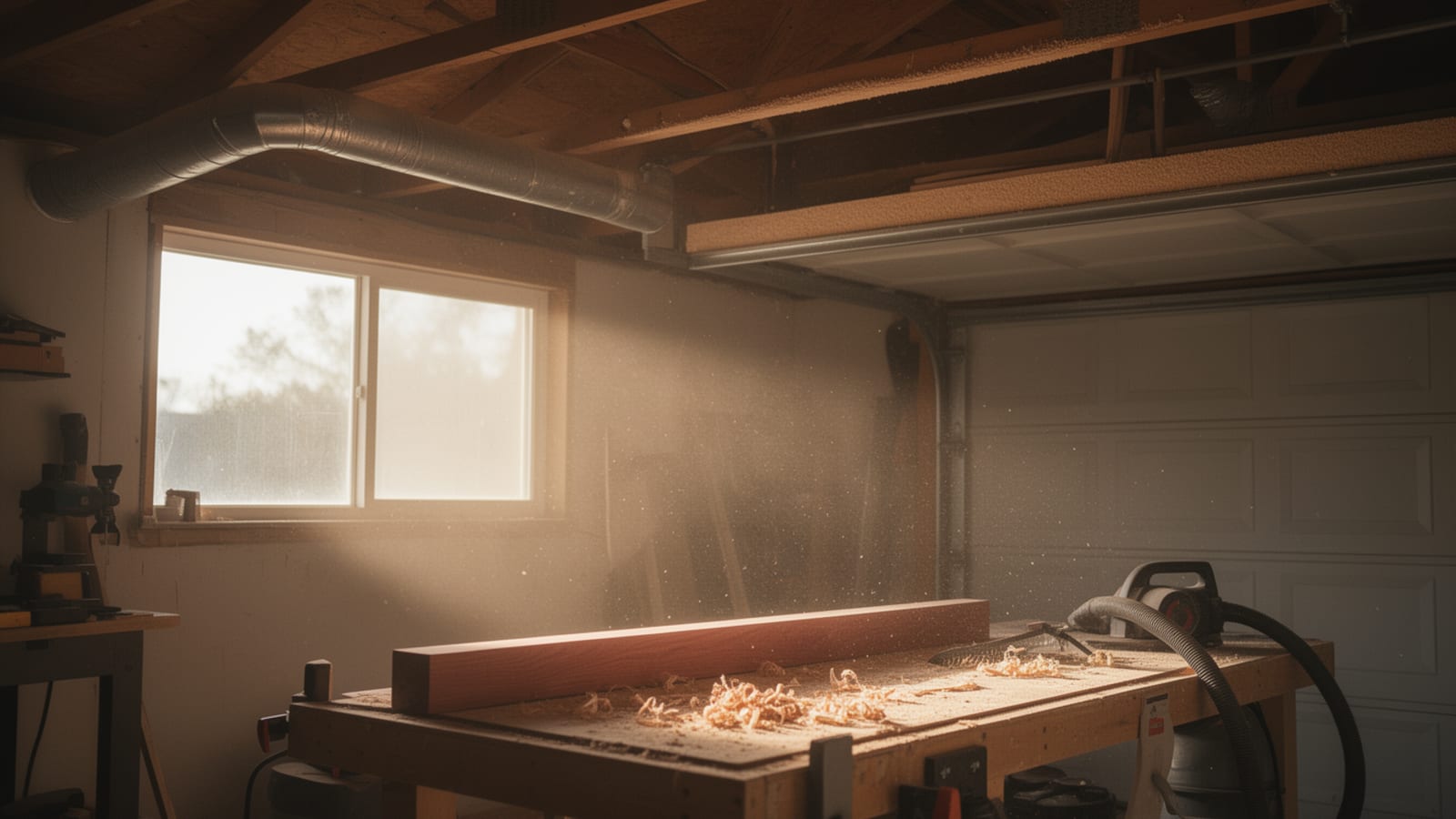
Here's the number that should actually reorganize your thinking about your shop. The ACT Group's housekeeping article makes the point that secondary explosions, not the initial event, are what destroy buildings. A small ignition shakes the settled dust off beams, joists, and duct tops into a cloud, and that cloud ignites all at once. The fine dust on top of your ceiling joists, above the garage door track, on the upper runs of ductwork, is the fuel that matters. Overhead surfaces deserve more of your cleaning budget than floors.
Why None of This Is Legal in Your Garage
NFPA 660 is a consensus standard, not a regulation. The ACT Group is explicit that no federal law directly adopts it. So how do facilities get caught in its net? Three channels, all of which require one thing a hobby shop doesn't have: a commercial existence.
First, OSHA. The agency has no dedicated combustible-dust rule, so it cites employers under the General Duty Clause using NFPA standards as the technical basis, and it inspects under a Combustible Dust National Emphasis Program, per Coral USA's compliance overview. The General Duty Clause binds employers protecting workers. If you're cutting boards alone on a Saturday, you have no employees, which means no OSHA exposure. Full stop.
Second, fire codes. Local jurisdictions adopt NFPA standards by reference, and fire marshals enforce them. Third, insurers, who benchmark commercial clients against NFPA and price accordingly.
Notice the pattern. All three enforcement channels attach to facilities, employees, and commercial relationships. The predecessor wood standard, NFPA 664, framed its scope around industrial, commercial, and institutional facilities that process wood, and 660 carries that facility-oriented framing forward. I can't quote the scope clause verbatim, because the text wouldn't open for me, so I'll say it in general terms: the standard is written about places of business, not garages.
One honest caveat. Whether a local fire code's adoption of NFPA standards reaches a detached residential garage with a dust collector in it varies by jurisdiction, and I couldn't verify that either way. The right move is the unglamorous one: if it genuinely worries you, ask your local fire marshal. In most places I'd expect the answer to be no, but I won't assert it.
The Part Where I Argue You Should Follow It Anyway
Here's my position, and it's a preference, not a claim: NFPA 660 is the best free engineering playbook a serious hobbyist can read. NFPA makes its codes readable online through its free-access program. A shop-built dust collection system is exactly the kind of thing that benefits from consensus engineering, because the failure mode isn't a bad joint. It's a flash fire.
Start with housekeeping, because it costs nothing. Vacuuming is the preferred cleaning method under the standard; sweeping is tolerated where gentle; compressed-air blowdown is a last resort permitted only when surfaces are inaccessible and ignition sources are shut down. That ordering is pure physics. Blowdown aerosolizes dust, and an aerosolized dust cloud is precisely the condition you're trying to avoid creating. If your shop cleaning routine currently involves a leaf blower, that's the habit to retire first.
If you use a shop vac around fine dust, Nilfisk's summary of the standard's vacuum requirements is a useful spec sheet: conductive construction, static-dissipative hoses and wands, bonded and grounded components, and the motor on the clean side of the filter. That's the hardware you're paying for in a dust-rated vac.
On ductwork, I'll be straight with you: I have no verified minimum duct diameter to give you, because my research couldn't open the standard text, and I won't invent one. What I can pass along with proper attribution is a transport velocity figure of roughly 3,500 to 4,000 feet per minute for wood dust in ducts, which comes from the ACGIH Industrial Ventilation manual, not from NFPA. The principle behind it is what matters for a hobbyist: undersized ducts and undersized blowers let dust settle in the runs, and duct runs full of settled dust are both a clog waiting to happen and a fuel line. Design so the air keeps moving.
Two figures circulate from manufacturer sources that I'll present as exactly that. Höcker North America states that interior recirculating systems must filter out 99.9% of combustible dust, and that exterior collectors should sit at least 30 feet from the building. Those are manufacturer paraphrases of the old 664 practice, not figures I could verify against the standard. Treat them as rules of thumb from the industry, not gospel.
Where the Real Obligation Sits
I've come to believe the useful way to hold this standard is as a borrowed conscience. Your legal obligation as a garage woodworker is effectively zero under NFPA 660, and anyone who tells you the dust police are coming for your shop vac is selling something. But the standard encodes the accumulated lessons of sawmills that burned down, and it asks of a covered facility a documented Dust Hazard Analysis revalidated every five years, grounding and bonding, housekeeping on a schedule with named responsibilities, and training. Those requirements describe a discipline, not just paperwork.
Translate that discipline down to a two-car garage and it looks like this: vacuum rather than blow down, clean overhead surfaces first and often, buy dust-rated vacuum equipment, keep duct air velocities high enough that nothing settles, and think honestly about your collector's location. None of it costs much. All of it is justified by purpose rather than habit, which is the only kind of rule I trust.
Your next action is physical, not legal. Tonight, before the next project, take a flashlight into the shop and look up. Check the tops of the joists, the duct runs, the top of the cyclone lid. If you can write your name up there, you've found your real to-do list.