
HDPE Poly Lumber vs. Wood: Real Prices, Screw Hold, Sag, Heat, and Movement
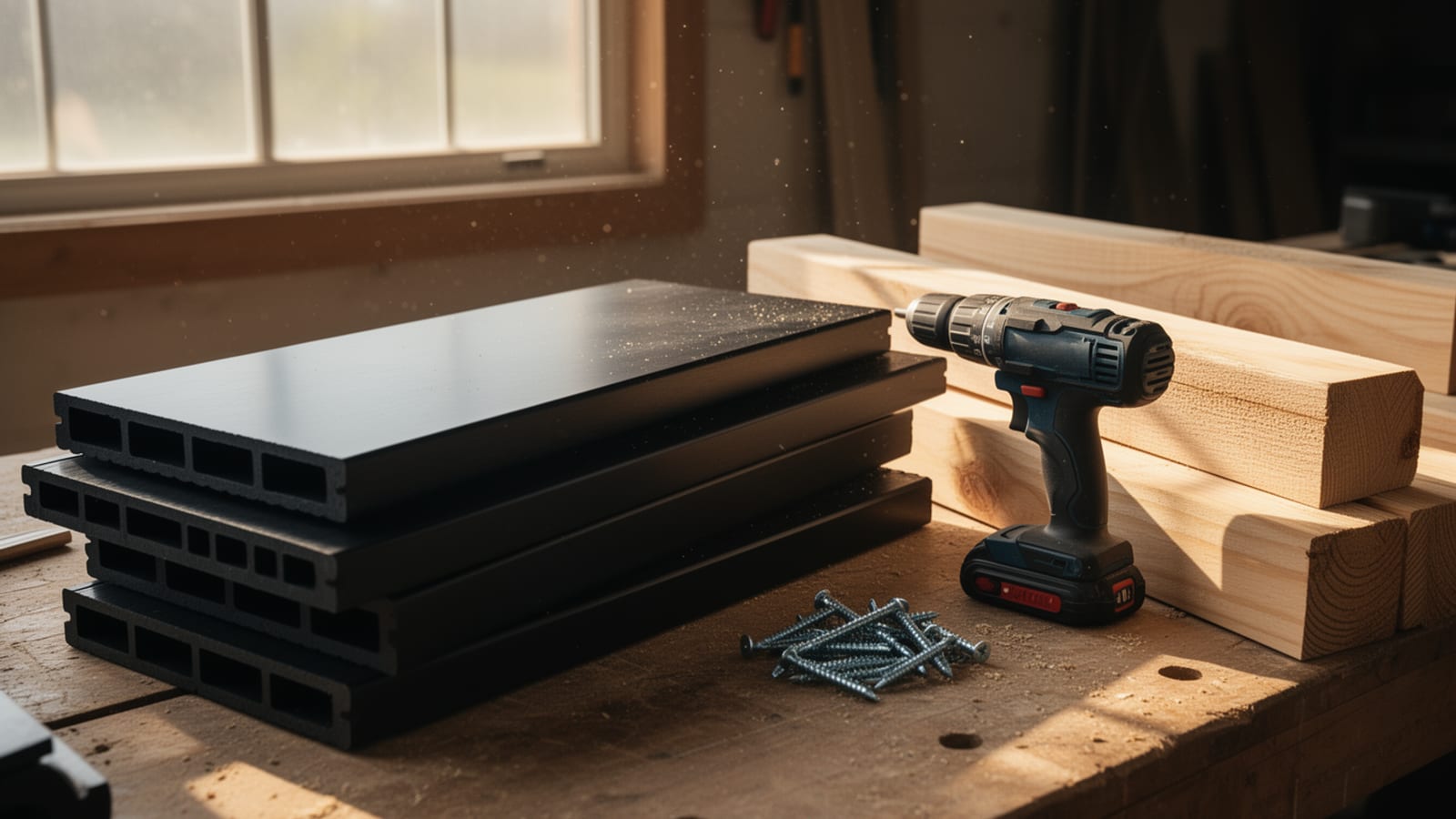
HDPE Poly Lumber vs. Wood: Real Prices, Screw Hold, Sag, Heat, and Movement - A step into the workshop.
Stop Wasting Wood
Generate clear cut diagrams instantly with our new Cutlist Optimizer. Plan your cuts to make your next build easier.
Somewhere in Texas right now there's a poly Adirondack chair sitting on a patio that hasn't been touched since the homeowner bought it. No stain. No re-sealing. No cupped slats. And next to it, probably, is a wood bench the owner has refinished twice. That's the pitch, anyway. The question is whether you should build your next patio couch out of recycled HDPE boards or stick with wood and a brush. I looked at the real prices, the fastener data, and what this stuff does in heat, and the answer is more split than the marketing suggests.
What You're Actually Buying
Recycled HDPE poly lumber is pure plastic, board-shaped. It's not the same thing as wood-plastic composite, which mixes plastic with wood fiber — the pure products are made solely from plastics, per Green Building Solutions. (Fair warning: that page has since picked up some spam junk in its navigation, so I'm only leaning on it for the material description and the standards list, nothing more.)
The boards themselves are honest dimensional stock. BearBoard's mineral-filled HDPE 2x4 comes in the actual size you'd expect from a wood 2x4, 1.5 by 3.5 inches, at 1.80 pounds per foot, in twelve colors and lengths from 6 to 16 feet, with a smooth finish on all sides, no woodgrain pattern, and a marketed limited lifetime warranty backed by UV-resistant anti-fading pigment. Markstaar's 100% recycled 2x4x8 board weighs 17.6 pounds, cuts and drills with standard woodworking tools. You can rout it, screw it, run it over the jointer. From a shop standpoint, that part is real.
The Price of "No Maintenance"
Here's where the romance ends. Markstaar's 2x4x8 recycled plastic board runs $24.91 in black, minimum quantity six, and if you want brown, cedar, gray, or green, add $5.12 per board. That's roughly $3.11 a foot in black, about $3.75 in color. The Plastic Lumber Store in Springfield, Ohio publishes per-board cash prices that tell the same story: a utility-grade 2x4x12 at $50, and their furniture-grade double-bullnose 2x4x12 at $90 in sand up to $120 in white. That's anywhere from about $4 to $10 a foot for furniture-grade stock. They also note, honestly, that plastics pricing fluctuates with oil pricing and changes daily, with quotes good only 30 days.
I couldn't verify a current big-box 2x4 price at publish time, so I won't pretend to a precise multiplier. But run it yourself at your local store: even a mediocre day on SPF framing lumber leaves poly several times more expensive per foot. BearBoard doesn't publish prices at all — quote only — so budget accordingly.
The retail comparison rounds it out. Food & Wine's 2026 tested round-up puts a Polywood Grant Park Adirondack at $179, the Highwood Hamilton at $250, and the West Elm Portside — real FSC-certified mahogany/eucalyptus, polyurethane-sealed — at $449. A $179 chair that never needs refinishing versus a $449 chair that needs re-sealing after a few years and a cover to boot. Over a decade, poly starts looking less like a luxury and more like math.
Screws Hold. Don't Get Cute.
Screw hold is the thing everybody worries about with plastic, and the numbers are better than you'd guess. American Plastic Lumber lists screw withdrawal for its Structural-X HDPE at 703 pounds per inch of thread depth under ASTM D6117-97, the standard test for mechanical fasteners in plastic lumber. That's a real withdrawal number, not a marketing claim.
Two caveats from the same data sheet, and they matter. First, APL cautions that drilling holes and routing edges can alter the integrity and strength of the part — so oversized pilot holes, the kind you'd use for wood movement, are cutting into a material with less structural margin to spare. Second, Missouri S&T ran an undergraduate study testing 10d galvanized nails and No. 10 flathead screws in Trimax plastic lumber on all three board faces at -20°F, room temperature, and 125°F. The test existed; I couldn't retrieve the actual pull-out numbers, so I won't quote them. What I'll say is this: if a university thought temperature was worth testing across a 145-degree range, you should assume fastener hold in HDPE is temperature-sensitive, and plan your joints accordingly.
Practically, poly furniture builders use stainless or marine-grade fasteners to prevent rust streaking, with color-matched plugs. Do that. Cheap screws in poly will streak like a bad tattoo.
The Heat Question, Answered Honestly
Now the fun one: what does it feel like at 100°F in a Texas August?
Here's what's verified. On a 78°F day at around 1pm, a deck builder with a heat gun measured composite deck surfaces at 167°F in the lightest color, 190°F in dark brown, and about 200°F in black, per Cascade Fence & Deck. That's 90 to 120 degrees above air temperature, driven mostly by color rather than material. Extrapolate to a 100°F afternoon — which is not extrapolation in Austin, it's a Tuesday — and a dark poly bench surface can push well past bare-skin pain territory. Lighter colors mitigate it. Same is true of dark-stained wood, for what it's worth.
What I can't tell you, honestly, is whether HDPE runs hotter or cooler than wood side by side, because I couldn't find a fetched source that measured both at 100°F air temperature, and the blogs that address it disagree. The honest answer: nobody's comparing them head to head, so the site owes you an IR-thermometer test on the same afternoon, same sun, black poly versus dark-stained oak. I'd bet on the poly running hotter longer, but a bet isn't data.
Sag: Where Wood Kicks the Door In
This is the axis where poly loses, and the manufacturers mostly admit it.
Plastic lumber is viscoelastic. Per Green Building Solutions, its mechanical properties are time- and temperature-dependent and subject to permanent deformation — creep — under sustained loads, with the creep rate depending on stress magnitude, duration, and temperature. Translation: a poly 2x4 couch slat loaded with three guys watching football doesn't spring back. It slowly takes a set, and it does it faster when it's hot. Which, in Texas, is always.
The stiffness gap is about an order of magnitude. APL's technical data lists a modulus of elasticity of 221,26 psi for Structural-X — that's a typo on their own page, and the actual figure is almost certainly around 221,000 psi — against wood, which most references put in the 1.6 to 2 million psi range, though I couldn't load an extension source to verify that before publish. That's why Markstaar says its plastic 2x4 is "more flexible than wood and should not be used as framing or support."
APL balances it with "greater impact resistance than wood but conversely less rigidity," and recommends an engineering review before structural use. So the rule is simple: poly for slats, aprons, and seat surfaces where spans are short and support is close. Never for legs, rails, or anything carrying a load over more than a foot or two of unsupported span.
Movement: The Number Nobody Budgets For
APL lists a coefficient of linear expansion of 0.0000281 in/in/°F under ASTM D6341-98, and warns outright that you'll see greater expansion than stiffer wood products and "an accommodation must be made to properly allow for expected expansion and contraction."
Run that number: an 8-foot black poly board going from a 70°F shop to 130°F surface temperature in the sun moves roughly 5/32 of an inch in length. Wood across grain moves with humidity, not just heat, and slower. If you build a poly bench with tight, wood-style joinery, the frame will fight itself every afternoon. Screw slats with elongated or oversized holes. Leave gaps. Design for movement the way you would for a wide solid-wood top, because the plastic gives it all back to you thermally instead.
The Verdict
If you're buying finished furniture, poly wins the lifetime-cost argument, and a $179 Polywood chair with a 300-pound capacity is hard to argue with. If you're building, the math flips: at $3 to $10 a foot, you'll pay several times lumber prices for stock that can't be a leg, can't span like wood, moves with the sun in a way wood doesn't, and drills differently than anything in your shop. Right tool for the job: poly for short-span slats and bench tops on a frame that carries the load, wood — dense and heavy and high-maintenance — for everything structural. I'd build the couch frame in wood and cap the seat and back in poly. You get no refinishing where your body sits, and stiffness where the frame needs it.
And run an IR thermometer over both on the first 100-degree day. Because somebody should.