
DIY Murphy Bed Hardware Compared: What $650 Actually Buys, From $199 Kits to Rockler
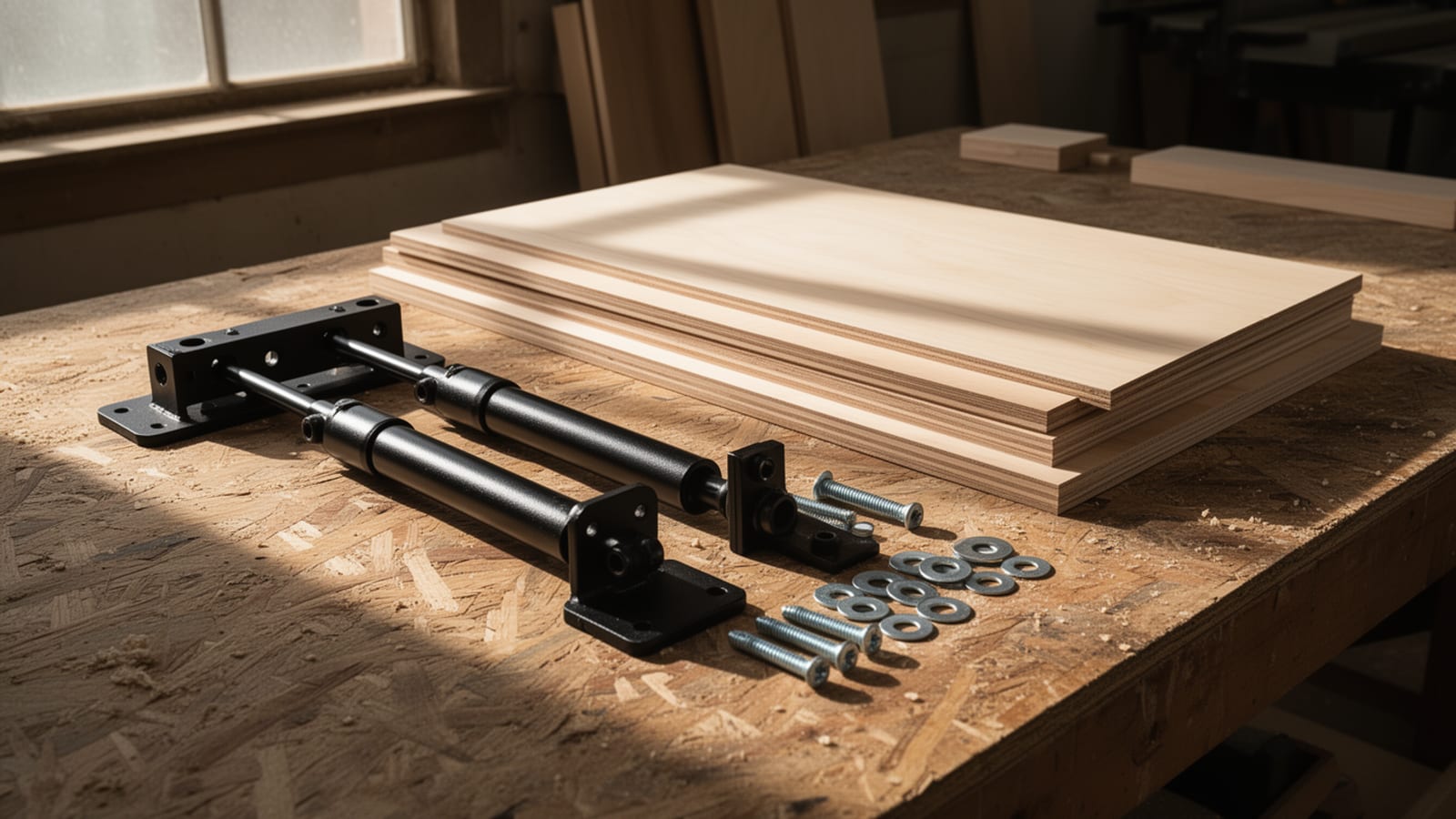
DIY Murphy Bed Hardware Compared: What $650 Actually Buys, From $199 Kits to Rockler - A step into the workshop.
Stop Wasting Wood
Generate clear cut diagrams instantly with our new Cutlist Optimizer. Plan your cuts to make your next build easier.
Yo, let me tell you a story about the most seductive number in small-space woodworking: $650. That's the figure floating around for a full DIY Murphy bed, all in. And look, it's not fake. The Spruce's full-size Murphy bed plan pegs the total at $600 to $700. But here's what I've learned from years of hauling slabs home on the subway and building in a second bedroom my landlord thinks is for guests: the number is real, and it's also hiding about three things you need to know before you commit.
So let's open up that $650 and see what's actually inside.
The Cost Stack, Line by Line
The Spruce's estimate breaks down roughly like this: a hardware kit at "a few hundred dollars," plus wood under $400 on average. That wood list is specific — one 3/4" sheet of 4'×8' sanded plywood, two 1/4" sheets, one 1/2" sheet, plus nominal pine in a bunch of sizes (2x4s, 1x8s, 1x6s, 1x4s, 2x2s), lag bolts, and finishing supplies.
Here's where the number frays. That math assumes a budget kit and construction-grade lumber. The "$650 all-in" claim only works at the cheap end of every choice. Which, honestly, is exactly the kind of math I do at 11pm. But you should know what you're choosing.
Also worth holding in your head: buying instead of building means over $3,000, with luxury models exceeding $10,000, per The Spruce. So even $800 DIY is still a massive win. The question isn't whether DIY saves money. It's whether the cheap version is safe.
The Hardware Ladder, From $199 to $2,175
You've got more options than the Rockler-vs-nothing binary the forums give you.
Wallbeds by Wilding runs a full DIY kit ladder: the P-100 piston-lift kit at $299 with free shipping and a lifetime warranty, the S-100 mechanism at $349 with articulating legs, the S-200 at $649 to $659 (their own site lists both, which tells you something about their bookkeeping), the S-250 bed-with-desk kit at $849, and the Total DIY Kit — cut lumber, metal frame, legs, mechanism, everything — at $2,175, though their sidebar says $1,849. Quote it as a range. Their kits carry weight limits of 1,500 to 2,000 pounds depending on the model, and most offer adjustable tension, though the P-100 and the D-200 desk kit don't.
On the budget end, Easy DIY Murphy Bed sells a queen vertical kit for $199, down from $289. It's rated for mattresses from 50 to 85 pounds, max 12" thick (and only 12" with the optional leg crossbar), black powder-coated steel, about 12 pounds of kit. Sounds great until you read the verified reviews: cut lists with errors, missing mattress-strap hardware at the end of the build, and one builder noting a queen build needs a 10'×10' clear area for assembly. Ten by ten. In my apartment, that's the whole room, furniture included. Plan your staging or don't start.
What You're Actually Swinging on a Pivot
This is the part nobody puts in the YouTube thumbnail.
The Easy DIY queen kit is engineered for a 50 to 85 lb mattress. Lori Beds' own queen mattress weighs 77 lbs. Add the bed frame itself and a realistic queen build is somewhere around 125 to 210 lbs swinging on that pivot every single cycle. That's not a cabinet door. That's a refrigerator you're asking to rotate smoothly.
And the weight window isn't just about strength — it's about function. Lori Beds notes that if the mattress is too light or too heavy, the mechanism behaves "erratically," opening or closing too fast or too slow. This is exactly why Rockler sells adjustability as the headline feature of the Create-A-Bed kit: a patented adjustable mechanism to balance different mattress weights, commercial-grade gas pistons, swing-down metal legs, all mounting hardware included, Limited Lifetime Warranty, made in USA. Wood and mattress not included — budget for that.
The Wall Is Part of the Mechanism
Here's the detail I think gets skipped most, and it's a safety one. The Spruce plans anchor the cabinet with twelve 1/4"×3-1/2" lag bolts with fender washers, into three horizontal 2x4 backer rails bolted to studs. Their plans state plainly that the bed "relies on the wall's strength during opening and closing."
Read that again. The wall is a structural component. If you're in an apartment like mine, that means locating studs, hitting them twelve times, and being honest with yourself about what's behind the drywall. Lori Beds' safety writeup identifies improper mounting — cabinet tipping or detaching from studs — as one of the top risk factors, alongside tension-mechanism failure and overload. Their documented fatality history (1982, 2005, 2014 Staten Island) is rare, and every incident was installation- or mechanism-related, never the concept itself. For perspective, they compile CPSC figures showing over 25,000 space-heater fires a year. A Murphy bed done right is not the scariest thing in your home. Done sloppy, it's a couple hundred pounds on a lever arm bolted to your wall.
Budget for the lag bolts and washers. They're part of the real cost stack, and they're non-negotiable.
So Is the Cheap Shop-Built-Hinge Approach Safe?
The LumberJocks thread "DIY Murphy Bed?" is the canonical record of guys trying to beat the kit price, and it's sobering. One builder priced out a Create-A-Bed equivalent at around $100 with shipping, and still abandoned the plan because of the time to build and weld his own pivots and because he had no idea what weight rating the gas shocks needed. He bought the kit.
Another builder: "If you price individual components you will find that good quality gas shocks large enough to do the job will cost nearly as much as the complete kit price." And a pro who builds around 80 beds a year put it simply: for $300, it's worth buying it.
The few DIY alternatives in the thread were Moddi-style builds using MSC Direct gas springs — again, dated numbers — but the missing piece was a proper pivot bracket, and Moddi's design got criticized for MDF sagging and tearing. Another builder's horizontal melamine build sagged on the longest member and had to be reinforced with steel angle. Sag on a bookshelf is annoying. Sag on a counterbalanced bed changes the whole geometry of the lift.
And here's the scariest line in all the research, from Lori Beds: DIYers attempting repairs on tensioned parts have caused "snapping or sudden, violent closures." If you build your own spring or pivot system, you are also the person who services it. That's the risk the kit price is actually buying you out of.
Springs versus pistons matters here too. Per Wallbeds n' More, springs can be re-tensioned when the bed sags open; fatigued pistons can't be adjusted — they get replaced entirely. Piston systems often add a locking feature that holds the bed closed regardless of piston fatigue, which is a genuine safety argument for them. Meanwhile, vendors disagree with each other: Wilding's main site claims gas-piston wall beds handle 4,000 lbs versus 2,500 for springs; Wallbeds n' More says the choice "doesn't really matter." Different companies, different incentives. Treat all of it as vendor claims, not gospel.
My Verdict, as the Guy With No Truck
I've got no garage, no dust collection, and definitely no welder. The forum record matches my instincts: fabricating your own counterbalance is the one part of this build where DIY doesn't save money so much as transfer risk from your wallet to your body. Unknown shock weight ratings, homemade pivots, tensioned springs you'll someday have to service — that's a bad trade to save a couple hundred bucks.
The honest math: The Spruce's $600 to $700 works with a budget kit, pine, and three plywood sheets — one 3/4", two 1/4", one 1/2" — plus a meticulous twelve-bolt stud anchoring job. Swap in the full-price Rockler Create-A-Bed queen and the total lands higher than that; the research doesn't say by exactly how much. Either way, you're beating the $3,000 retail floor by thousands.
Buy the mechanism. Build the cabinet. Lag it into studs like your life depends on it, because sort of, it does.