
Drum Sander vs. Planer: What a Benchtop Drum Sander Actually Buys You
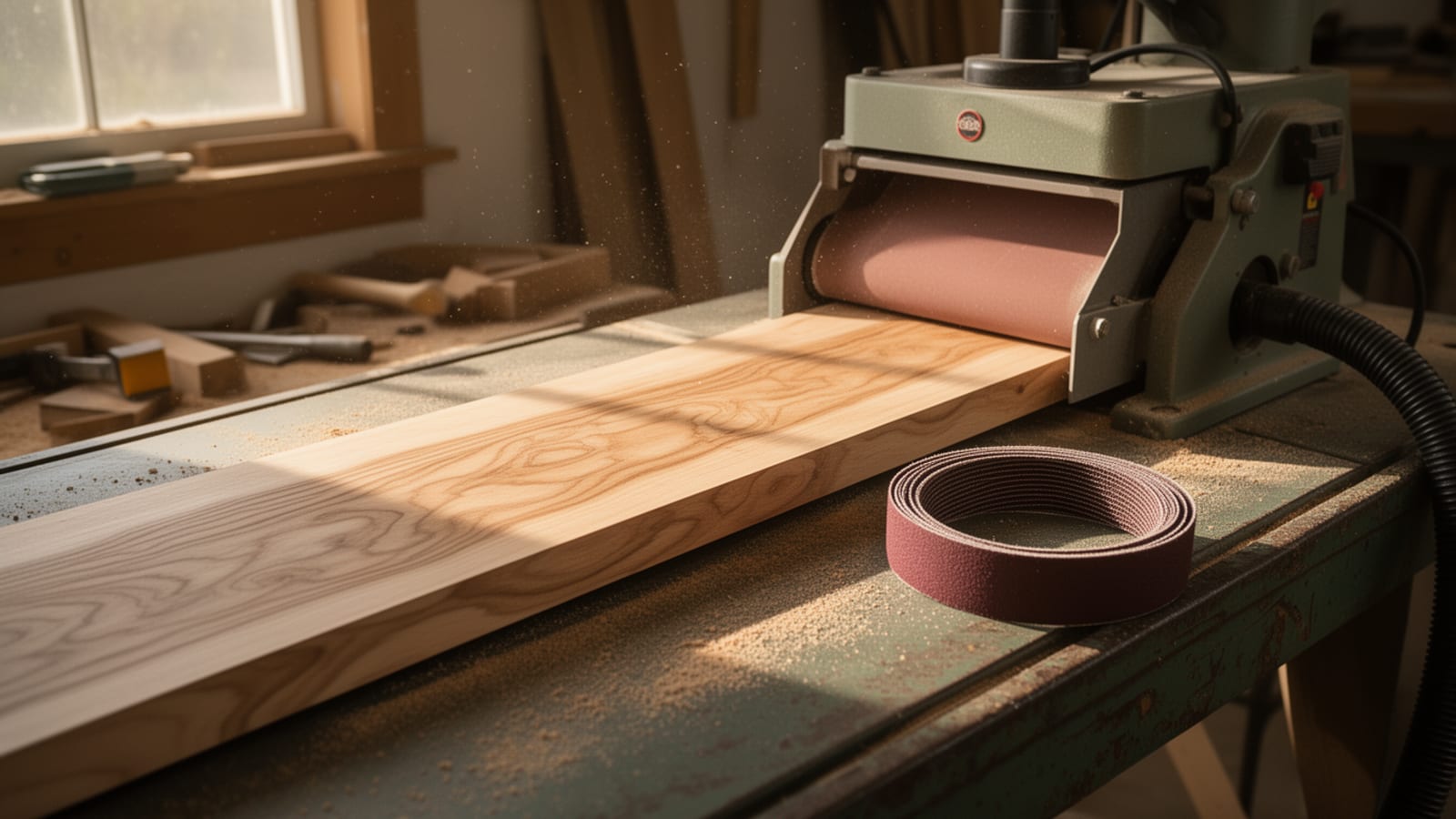
Drum Sander vs. Planer: What a Benchtop Drum Sander Actually Buys You - A step into the workshop.
Stop Wasting Wood
Generate clear cut diagrams instantly with our new Cutlist Optimizer. Plan your cuts to make your next build easier.
We've all been there. You glue up a big panel or an end-grain cutting board, then spend a whole evening at the random-orbit sander trying to kill the machine marks before anyone notices them under finish. Somewhere around grit 120, the forums start whispering: you need a drum sander. And then the same forums turn around and call it a luxury buy. Which is it?
I went looking at the actual numbers, and the honest answer is: both, depending entirely on what you're asking the machine to do. Let's run the math hobbyists never see.
The 25-Pass Problem
Here's the figure that should anchor every decision on this topic. Michael Dresdner, writing in Rockler's planer-vs-drum-sander guide, puts it plainly: a drum sander removes about 0.005" to 0.007" per pass, while even a small 12" portable planer removes 0.125" to 0.250" per pass. His arithmetic says it takes roughly 25 passes through a drum sander to equal one pass of a planer. The abrasive maker Sheartak's guide repeats the same ratio and calls it what it is: a planer removes material 25 times faster.
And it's not just slow. Lee Grindinger, Rockler's second expert on the same page, points out that aggressive "abrasive planing" means running very coarse grit, which then forces several grit changes to get back to a smooth surface. QuickWood, a brush-sander manufacturer, is blunter still: "Knives dimension; abrasives finish." In their view a drum sander simply can't dimension stock economically. I don't disagree, and neither should you.
So if you're buying rough lumber and milling it to thickness, the planer isn't optional. Full stop.
What a Benchtop Drum Sander Can Actually Do
Before we write the sander off entirely, look at what WOOD Magazine measured when they tested five drum sanders under $1,200 (review text published online, tested in their May 2009 issue). They covered the Grizzly G0459 and Shop Fox W1740 on the closed-end side, and the Delta 31-260X, Jet 10-20 Plus, and Jet 16-32 Plus on the open-ended side.
The numbers are more respectable than the forum chatter suggests. With fresh 60-grit belts, all five machines removed 3/64" from a 12"-wide workpiece at a feed rate of 6 feet per minute, and that exceeded the manufacturers' own recommendations. Most machines deflected no more than 0.004" across the width of the workpiece when taking cuts up to 1/64" per pass in red oak, cherry, poplar, and pine. Closed-end machines resist deflection better; on open-ended drums, over-aggressive cuts can spread the open end and leave you with a crowned panel, so take the gentle passes.
Two practical notes from that test worth knowing before you buy. First, the open-ended machines sand twice the drum width by flipping the workpiece end-for-end, but WOOD found the real usable width came up 1/8" to 1/4" short of the claimed doubled width. Second, the abrasives themselves are narrow wrapped belts with tapered ends, held on with hook-and-loop or spring clips depending on the machine, and WOOD called the wrapping process "tedious" and trial-and-error. Also, these machines make heavy fine dust: WOOD found 4" dust ports performed noticeably better than 2.5" ports with either a shop vac or a dust collector. If your dust collection is a bucket and a prayer, budget for that first.
Their verdicts: the Jet 16-32 Plus took Top Tool and the Jet 10-20 Plus took Top Value. One caveat, and I'd be doing you a disservice to skip it: that test dates to 2009. Current models carry drifted names, like the Jet JWDS-1632 Lowe's lists today, and I can't tell you whether today's versions perform identically.
The Consumables Story Nobody Prices Honestly
Here's where the angle gets real. Fine Woodworking forum veterans have been making this case: drum roll paper is very expensive compared to sheet sandpaper, and sandpaper doesn't last as long as knives. A well-adjusted planer with sharp blades is the cheaper thicknesser, they argue, with width as the only exception. That's forum opinion, not measurement, so weigh it accordingly. But the component prices back it up.
Woodcraft currently lists SuperMax pre-cut drum wraps for the 25" sander at $26.99 for a single wrap, regularly $29.99, in grits from 24 through 220. And one wrap covers one grit on one drum. So every time your abrasives wear out, a full 24-to-220 progression is a multi-grit purchase, not a single one. Against that, one Sawmill Creek forum user reported paying $60 to have a set of planer blades sharpened. Knives get sharpened occasionally; wraps get bought repeatedly. That's the structural difference.
I want to be careful here: I couldn't find a published cost-per-board-foot comparing the two, and I'm not going to invent one. What I can tell you is that the direction of the math is consistent across every source I looked at. The sander costs more per board foot to run. What you're paying for is what it does that the planer can't.
Where the Sander Actually Earns Its Spot
Two jobs, and I think they justify the machine for plenty of small shops.
First, end grain. A planer cannot safely thickness end grain, and anyone who has made end-grain cutting boards knows the pain of flattening one by hand afterward. The drum sander can thickness end grain, which makes it the tool for final-flattening those boards. Woodcraft's own product Q&A confirms those pre-cut wraps get used for exactly this. If cutting boards are your bread and butter, or your wedding-gift staple, this alone is a real argument.
Second, figured wood. Both Rockler's Dresdner and QuickWood independently point to tear-out as the sander's killer feature. Curly maple and birdseye that tear out under planer blades no matter how light the cut? The drum sander surfaces them without incident. For gift-grade work where the figure is the whole point, that matters.
Also know what it doesn't do: a drum sander leaves straight-line scratches and doesn't replace final random-orbit sanding. WOOD found drum-sanded surfaces still needed light work from a random-orbit sander. It's a better starting point, not a finish line.
So Which One Do You Buy?
The Home Woodworker, a 30-year cabinet-shop veteran writing for hobbyists, gives the most useful rule I found: buy the drum sander first if you buy pre-planed (S3S) lumber; if you dimension rough lumber, you need the planer, because a drum sander alone is too slow. He even says he'd take a 22" drum sander with 24-grit over a planer if forced to choose one, then immediately concedes he'll head to the planer if it's an option, because abrasive thicknessing takes more time. That's the most honest sentence in this whole debate.
The width story seals it. Benchtop planers cap out around 13" of width, and going past 20" wide in a planer will cost thousands of dollars. Even base-model open-ended drum sanders handle panels around 20" and wider, which is exactly the territory of a tabletop glue-up. The sander's core justification isn't speed. It's width, plus end grain, plus tear-out-free figured stock.
As for the budget bracket in the title, be careful. The only price point I could verify under $1,000 is a $600 street-price figure for the Jet 16/32 Plus that came up as fair in a woodworking group discussion in early 2025. Current new retail prices for the Jet and Shop Fox benchtop machines weren't something I could confirm, and the SuperMax 19-38, with its 19" drum and a 6" total width advantage over the 16" machines when using the flip technique, has historically sold at $1,399 to $1,600, which puts it well outside this bracket.
My Take
My lettering skills have always left something to be desired, and so has my patience for hand-sanding a glue-up for three hours while the kids ask what's for dinner. If your shop is built around pre-milled lumber and finished pieces, cutting boards especially, a drum sander is not icing. It's the tool that makes wide panels and end grain practical. If you're dimensioning rough lumber, buy the planer first and let the sander wait, because 25 passes is 24 more than you want to make. And if money's genuinely tight, there's always the minority report from a Fine Woodworking forum poster: skip both, and flatten with a #4 and #5 hand plane and winding sticks. Slower still, but the sawdust is free.