
Minimum RPM for Forstner Bits: What Budget and Variable-Speed Drill Presses Actually Deliver
Minimum RPM for Forstner Bits: What Budget and Variable-Speed Drill Presses Actually Deliver - A step into the workshop.
Stop Wasting Wood
Generate clear cut diagrams instantly with our new Cutlist Optimizer. Plan your cuts to make your next build easier.
Yo, let me tell you a story about the worst $40 I almost saved.
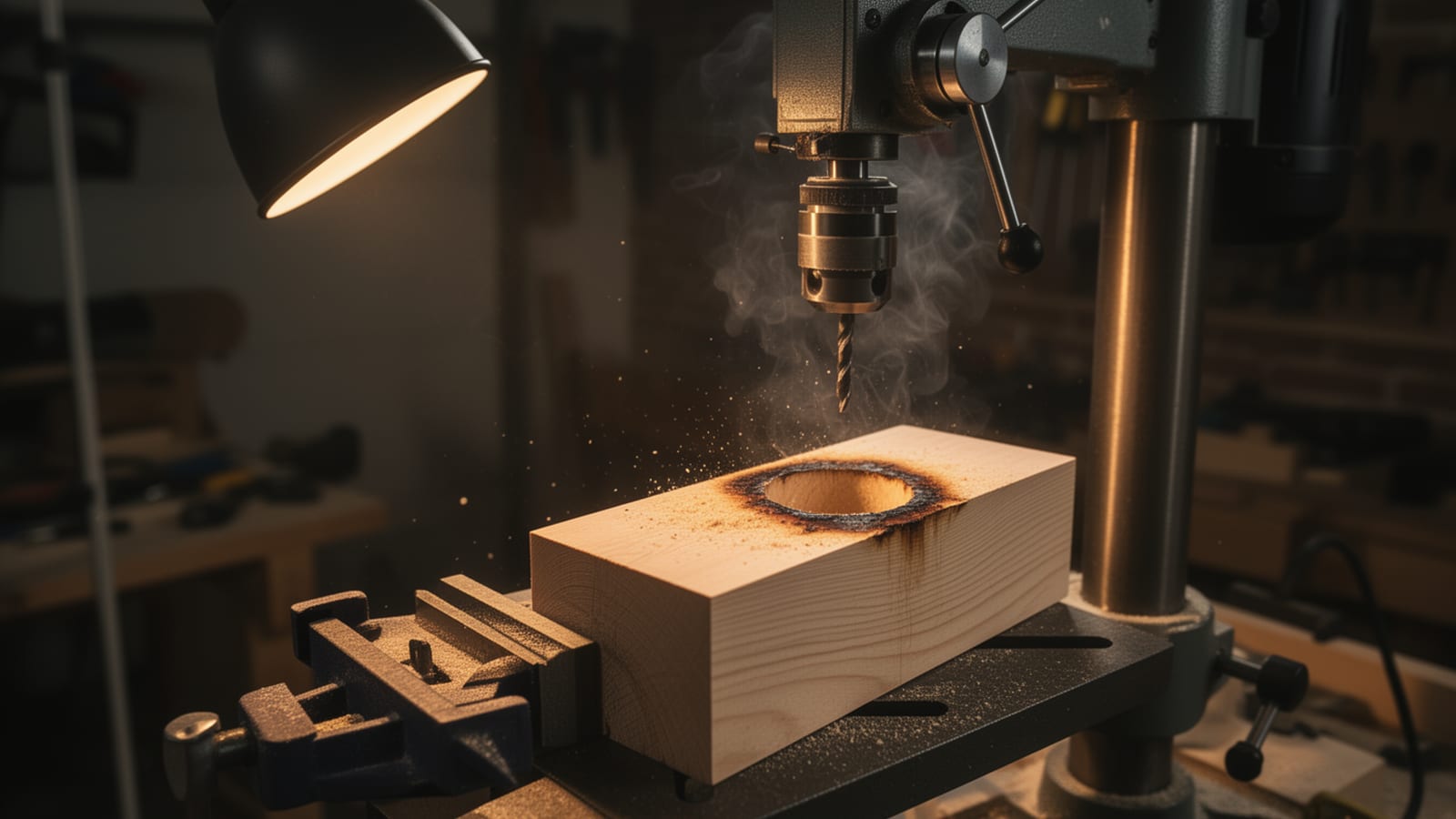
I'm in a buddy's shop out in Queens, boring 1-1/2-inch holes through some hard maple for a set of shelf pins gone wrong, and his drill press is screaming like the Q train on a curve. The maple's smoking. Not smoking like "there's a character to this." Smoking like the bit is being ruined in real time. He's got a benchtop press, a cheap one, and he's got it geared as low as it goes. And that's the problem. Its low gear isn't low enough.
That's the whole game with these machines, and almost nobody shops for it. You look at swing, you look at price, you look at whether it's got a laser. You should be looking at minimum RPM.
The Number Nobody Puts on the Box
Tool Croze's Forstner speed chart gives hardwood targets: around 700 RPM for small bits 1/4 to 3/8 inch, 500 RPM for 1/2 to 1 inch, and 250 RPM for 1-1/8 to 2-inch bits. That's the floor. And their cue for when you're too hot is one worth memorizing: when drilling makes dust instead of chips, the speed is too high. Excess speed and pressure just overheats and dulls the bit you paid good money for.
And check this twist: the General International 75-010 was a variable-speed machine, and WOOD still flagged it for lacking "the low-end speed a woodworker needs for big bits." Variable speed as a feature label means nothing. The spec that matters is the number at the bottom of the range.
The Budget Contenders, Screwed Down Low
The cheapest path into the game is the 5-speed belt-drive machines, and their bottom pulley is actually decent.
WEN's own page lists the 4210T, a 10-inch 5-speed, at five speeds of 570, 900, 1390, 2050, and 3050 RPM. WEN sold a manufacturer-refurbished R4210T for $125.30 with a 90-day warranty, though it's listed sold out right now. That 570 RPM floor sits above Tool Croze's 500 RPM target for 1/2- to 1-inch bits, so it falls short of the chart even before you get to the big ones. Not perfect. Workable.
The SKIL 3320-01 runs a stepped-pulley system across the same spread, 570 to 3,050 RPM. Toolstash's review reports running Forstner bits from 3/8 up to 1-1/2 inches in hardwood at the lower speeds without bogging. Home Depot carries it; I couldn't verify a current street price, so do your own homework there.
The catch with these isn't speed. It's the belt change. WOOD Magazine found manual belt changes "cumbersome" on most of the machines they tested, either because the motor didn't slide forward enough to relieve belt tension or because tension couldn't be restored afterward. On a $130 press with a 5/8-inch bit in the chuck, you'll be up in that belt housing more than you'd like, wrenching on a spring. Nobody's published timed numbers on how long that takes, but "cumbersome" tells you what you need to know.
What Variable Speed Actually Costs
The WEN 4214T is the poster child for the mid-price class. WEN lists it at 580 to 3,200 RPM adjusted with the turn of a lever, no belt changes, with a digital LED readout showing actual spindle speed. Twelve-inch swing, 3-1/8-inch spindle travel, 5/8-inch keyed chuck, laser and work light, two-year warranty, 85 pounds. Price direct from WEN: $309.60. Amazon had it at $217.47 on April 23, 2025 per a Slickdeals deal post, which is a real discount if you catch one.
The JET JWDP-12 is the other name in this bracket: per Amazon and JET listings, mechanical variable speed from 530 to 3,100 RPM with a 1/2 HP induction motor, and the Trident Supply spec sheet lists the same 530–3,100 RPM range. I couldn't verify a current price from a live listing, so I'll leave it to you.
So what's the premium actually buying? Two things, and they're worth separating.
First, no belt changes. You dial the lever, the readout confirms, you drill. On a shop day where you're bouncing between a 1/4-inch bit and a 1-1/2-inch bit, that's the difference between drilling and fiddling. My own opinion: if you live in a Brooklyn second-bedroom shop like I do, anything that removes a fiddly step pays for itself fast, because every fiddle is happening two feet from your bed.
Second, and here's the uncomfortable part: the 4214T's floor of 580 RPM is basically the same as the 4210T's 570 RPM bottom pulley. The JET's 530 is barely lower. You're not buying a dramatically slower machine. You're buying convenience, a bigger table, a beefier chuck, and a readout that removes the guesswork.
The Machine That Had the Real Low End
Want to know what a genuinely slow benchtop looks like? The Grizzly G7943. Grizzly's own FAQ lists it at twelve speeds from 140 RPM up to 3,050, with 3/4 HP behind it and a 14-inch swing. WOOD Magazine made it their Top Tool pick among benchtop presses partly because of that range, and it was one of the machines that "continued to perform well with bits up to 2 inches." One hundred forty RPM. That's the number that actually handles a 2-inch Forstner the way Tool Croze's chart says it should.
Bad news: Grizzly lists it as discontinued. The used market is your friend there, if you're patient. Which is a very NYC thing to say about power tools, but here we are.
Runout: The Spec War You Can Skip
I expected to write a whole section on runout, because that's the other thing people argue about in the comments. Turns out I can't, in a good way.
WOOD Magazine drilled hundreds of holes across all eight machines and reported that "none demonstrated any runout (bit wobble)." Measurable runout was not a differentiator among the benchtop presses they tested. And manufacturers rarely publish runout specs anyway, so there's nothing to compare on paper. My take: stop worrying about it at this price class and spend your worry on the low end instead.
Torque, or Where Benchtops Stop
Power's the other ceiling. In WOOD Magazine's load test, all eight machines drove a 1-inch Forstner in oak and hard maple easily. But the Craftsman 34983 and the Ryobi DP103L stalled regularly with larger bits, while the General International and the Grizzly handled bits up to 2 inches. Their general guidance is blunt: if you regularly bore holes larger than about 2 inches, you need a floor-standing press. Benchtops run out of power there. For context, the Delta 18-900L, a 16-speed floor model, sits just above this price class at the big boxes, and that's roughly where $600 stops buying benchtop.
My Verdict From the Second Bedroom
Here's how I'd spend your money, and mine.
If your big-bit work tops out around 1 to 1-1/2 inches and you don't mind pulling a belt housing cover a few times a session, the 5-speed units are the honest buy. The 570 RPM floor is real, the price starts around $125 for a refurb.
And if you genuinely need to bore 2-inch holes regularly? WOOD's advice holds. Save toward a floor press, or hunt down a discontinued G7943 used. Don't buy a benchtop and nurse it with a feather-light feed and a prayer. I've watched that maple smoke. It doesn't end well.
Shop the minimum RPM. Everything else is marketing.