
Circle-Cutting Jigs: Router Trammel vs. Bandsaw Sled vs. Table Saw Pin Jig
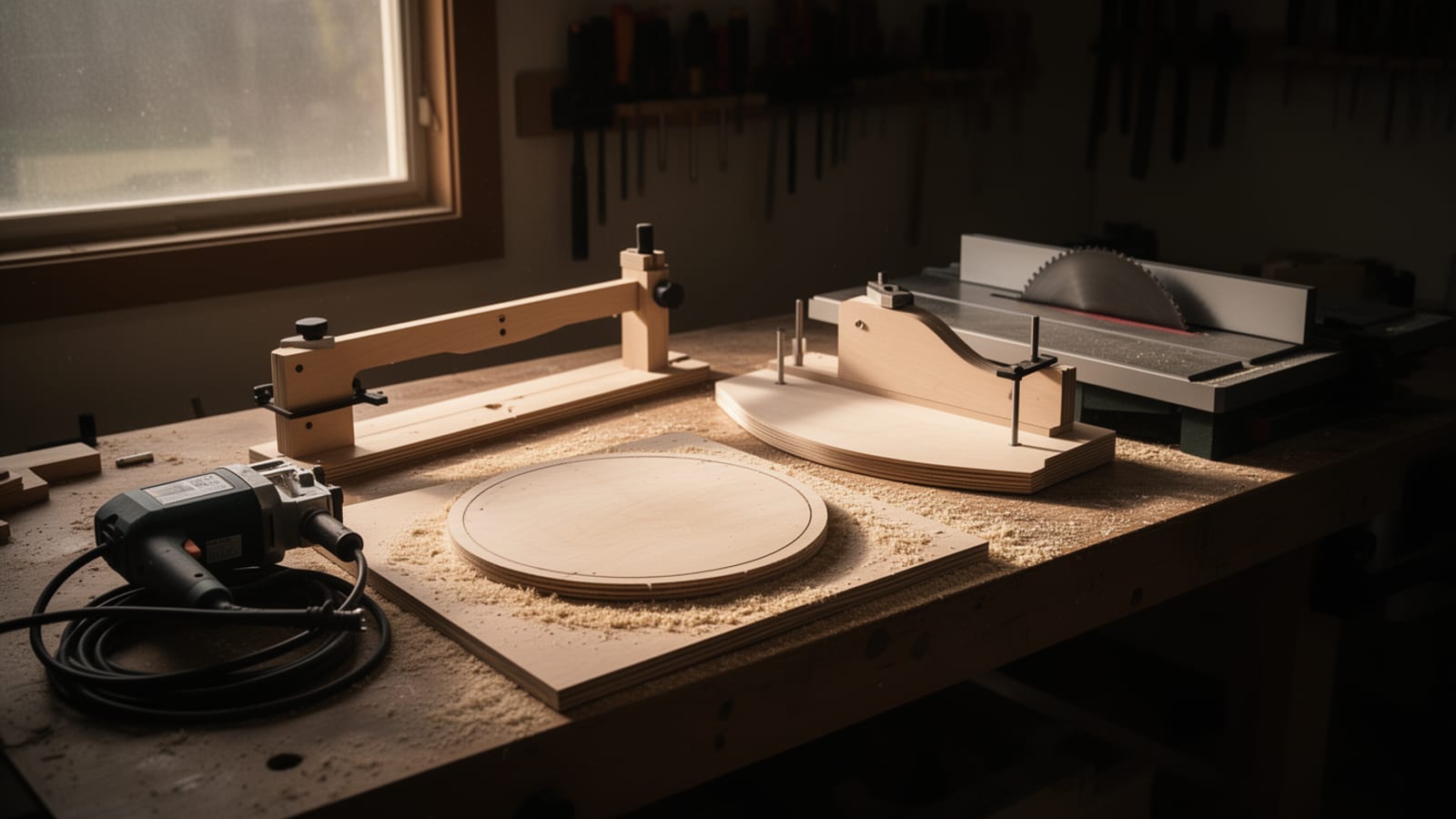
Circle-Cutting Jigs: Router Trammel vs. Bandsaw Sled vs. Table Saw Pin Jig - A step into the workshop.
Stop Wasting Wood
Generate clear cut diagrams instantly with our new Cutlist Optimizer. Plan your cuts to make your next build easier.
Yo, let me tell you a story. Last month I'm on a forum at 1 a.m. — don't ask why, the answer is insomnia and a neighbor's chihuahua — and I find a thread called "Router vs. Bandsaw Circle Cutting Jigs" on Sawmill Creek from back in 2022. Grown adults. Arguing about circles. One guy swears by his bandsaw sled, and the moderator comes in and says bandsaw jigs "tend to be less accurate than a plunged router cut with a fixed trammel."
Classic forum stuff. Except this argument actually matters if you're me: second bedroom shop in Brooklyn, no truck, and a $60 ceiling before my landlord notices the power bill. So let's settle it the only way I can — with what the sources actually say, what I've seen in my own scrap-bin testing, and an honest word about where the numbers get thin.
First, The Budget Problem
You cannot buy your way into this comparison. The Jasper Circle Pro 200, which is the commercial benchmark for router circle jigs, is a CNC-machined acrylic plate that cuts 256 circle sizes from 2-1/4" to 18-3/16" in 1/16" increments. Beautiful. The Woodsmith Store sells it bundled with an Amana 1/4" spiral up-cut bit for $74.95. Already over budget, before a single pivot pin.
The bandsaw side is worse. Woodhaven's Band Saw Circle Jig runs $235.99 across its three models, which cut circles up to 45", 69", or 91" depending on the rail length. Nice jig. I could buy a used bandsaw for that on this island. Maybe.
So everything below is shop-built. Plywood, MDF, CA glue, brads, a nail. Which, honestly, is the Brooklyn way anyway.
What "Cleaner" Even Means
Here's the thing I need to cop to up front: there is no instrumented answer published anywhere. No measured roundness deviation, no tear-out counts, no stopwatches. The forum argument runs on vibes and scarred thumbs. What we do have is consistent user reporting and one editorial claim, and they don't fully agree.
The Sawmill Creek crowd crowns the router. Moderator Prashun Patel says circles under 2" thick are best cut with a plunge router, and the fixed trammel wins on accuracy. That tracks with my experience — a router bit spinning in one position doesn't wander the way a blade being fed by hand can.
But Popular Woodworking's "Tablesawn Circles" article by Roger Holmes takes the opposite side: "The circular blade leaves a cleaner edge than a bandsaw blade does and it won't tear out the end grain, the way a router bit can." Fully supported blank, no pivot notch, cleaner than a bandsaw. That's a single magazine technique article, editorial opinion, not test data. Still, it's not nothing.
And the bandsaw? Both sources kind of dunk on it. Sawmill Creek users report bandsaw edges need sanding and tear out on the bottom. One member shrugs that it's "not a big deal" — severity contested — but multiple people say it. Patel's summary: the bandsaw "cuts more efficiently than a router, but... it requires sanding and it tears out on the bottom."
So the honest scoreboard: router for accuracy, table saw for edge quality on big circles, bandsaw for speed and thick stock, sanding mandatory.
The Tear-Out Question, Bit By Bit
Router tear-out is real and it's specific. The Sawmill Creek thread notes router cuts are "notoriously tricky" at the end-grain-to-long-grain transitions on a circle, and that this tear-out "can damage the edge irreparably." That word — irreparably — should scare you. A circle is nothing but grain transitions going around and around.
The fix is the bit. Compression or spiral bit, minimum. Richard Coers in the same thread recommends a 1-1/4" diameter top-bearing Freud pattern bit, arguing the larger diameter gives higher tip speed and very little flex. And note what that does to your budget: a good spiral or compression bit is the whole cost of this project. The jig is free. The bit is not.
The bandsaw's tear-out is dumber but fixable: it blows out the bottom edge where the blade exits. Backer board underneath, per the thread. Costs you thickness capacity, though — Woodhaven explicitly says its jig eats 2 inches of your bandsaw's thickness capacity. On a small saw, that's brutal.
Thickness: Where the Argument Actually Resolves
This is the part the forum fights skip, and it's the real answer. These three tools aren't competing for the same job.
Router: best under 2" thick. That's Patel's rule of thumb, one experienced guy's number, not a spec — but the physics checks out, since you're depth-limited by bit cutting length and router power. Coers offers a workaround: cut down 1/2" with the circle jig, then finish with a 1-1/2" long pattern or flush-trim bit. Doable. Fiddly. Slow, because you're making multiple shallow passes through full-thick stock.
Bandsaw: wins thick stock, full stop. And diameter is its superpower — Woodcraft's shop-built sled design (Andy Rae's write-up) handles circles up to 6 feet across, and the slide-and-cut entry means you don't have to notch your blank to reach the pivot. Notching a blank is the classic bandsaw jig pain; the forum guys describe locking the jig and rotating around the pivot as "awkward."
Table saw: Popular Woodworking's method safely handles diameters from 12" up to within an inch of your rip fence capacity, with the blade raised fully and an ATB blade of at least 40 teeth. Below 12", you're into jig territory anyway.
So: thin and precise, router. Thick or huge, bandsaw. Big and flat, table saw. The forum argument only exists because everyone was cutting different blanks.
Setup Time, Honestly
Nobody's published stopwatches, so here's the shape of each workflow instead.
Table saw, Popular Woodworking style: rough-saw the blank 1/4" to 1/2" oversize with a jigsaw, then nibble — repeated passes taking about 1/16" per rotation, where a 1/16" fence reset drops the diameter 1/8". Multiple full rotations. Deliberately slow, deliberately low-risk.
Table saw, Pretty Handy Girl style: the jig is 3/4" plywood or MDF, a miter-slot runner, a 1-1/4" pivot nail, CA glue and brads — basically the scrap bin. The workflow skips the multi-pass grind: cut the corners off (rotate 45°, cut, rotate 90°, repeat), then nibble to the line. The author reports cranking out 14 circles for tables in short order once the jig existed. That's the version I'd build.
Bandsaw: entry cut to the pivot, then rotate. Fast per circle once you're rolling, but awkward per the forum, and big circles need outboard support.
Router: multiple slow passes for anything thick, but Patel and fellow moderator Jim Becker say it "can be easier to set up, especially for larger diameter workpieces" — the workpiece sits on sawhorses and you walk around it. In a Brooklyn apartment, walking around a workpiece beats a commercial sled like the Woodhaven that eats 2" of capacity. I don't have a 2"-budget anywhere.
The Hybrid Nobody Talks About
Buried in the Sawmill Creek thread, the best idea in the whole argument: rout a partial-depth groove with your circle jig, jigsaw out the bulk of the waste, then finish with a bearing flush-trim bit riding against that routed edge. You get router edge quality without routing through an inch and a half of waste. The thread associates it with Andy Rawls' videos. This is the method I'd use for anything in the 1" to 2" range where edge quality matters — think clock faces, lazy Susans, tabletop rounds someone saw in a SoHo gallery and now you're quoting at a tenth of their price tag.
My Verdict
Build the table saw jig first. It's effectively free — plywood, a runner strip, a nail, some pennies to shim the runner — and it covers the most common job, flat rounds from 12" up. Popular Woodworking's claim about edge quality holds up in my shop experience: no bottom blowout like the bandsaw, no end-grain shredding like a dull router bit.
Then, if you cut circles more than a few times a year, add the router trammel with a proper spiral or compression bit for anything under 2" thick where roundness is the point. Keep the bandsaw sled for thick stock and diameters the other two can't reach — 6 feet, per Woodcraft's design, is a real number.
The forum argument dissolves the moment you ask one question: how thick, and how big? Answer that, and the jig picks itself. And your wallet stays under $60 — minus the bit. The bit is always the catch.