
Shop Noise Measured: Planer, Router & Vac Decibel Levels vs. Real NRR Protection
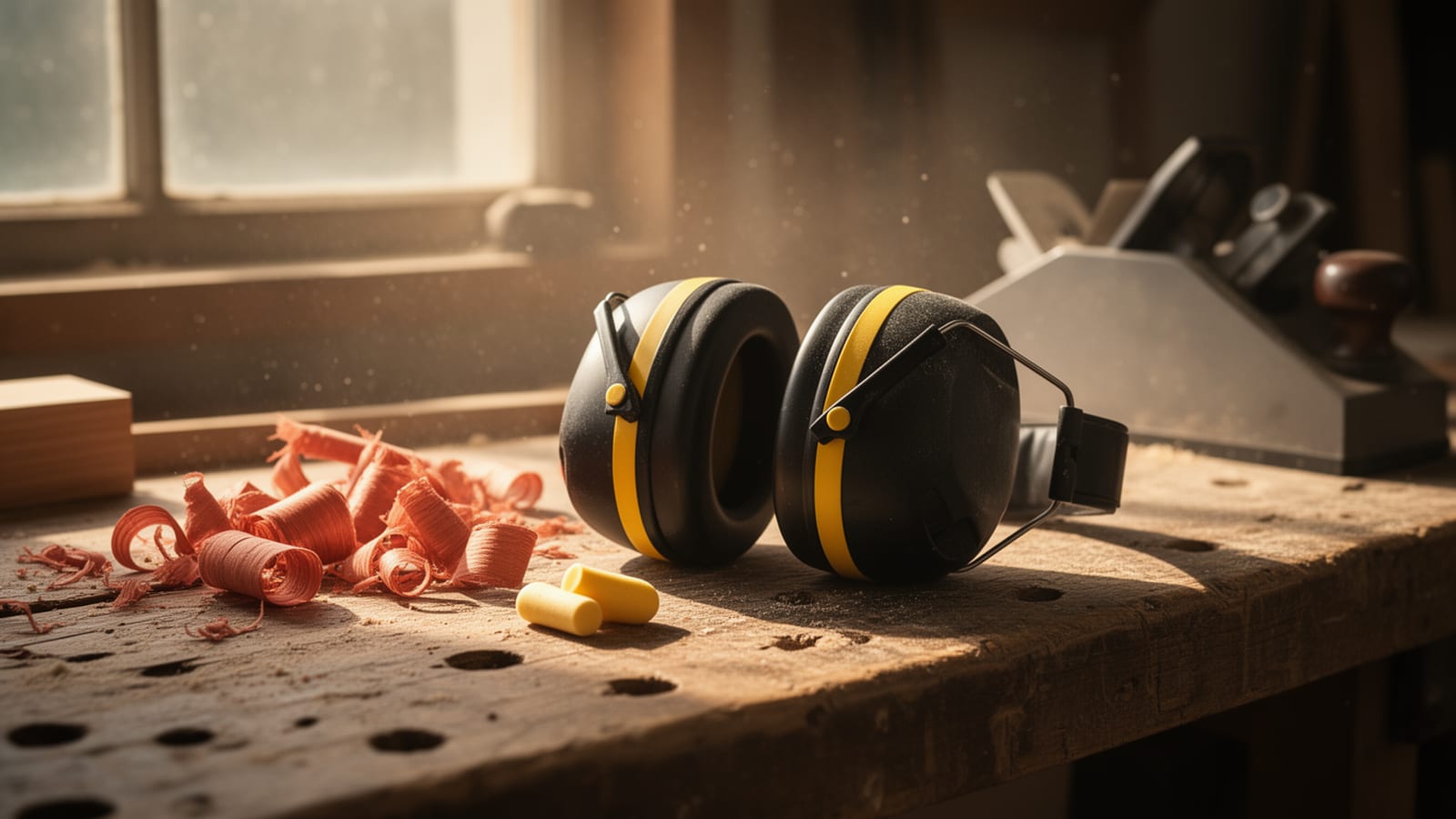
Shop Noise Measured: Planer, Router & Vac Decibel Levels vs. Real NRR Protection - A step into the workshop.
Stop Wasting Wood
Generate clear cut diagrams instantly with our new Cutlist Optimizer. Plan your cuts to make your next build easier.
We've all been there. You finish a long planer pass, the dust settles, and your ears are still ringing while your kid asks what's for dinner. You dig out those foam plugs from the drawer, give them a half-second squeeze, and get back to work. And you probably assume you're protected.
After spending some time with the actual numbers, I can tell you that assumption deserves a second look. Let's dig into what your shop really sounds like, and what those NRR labels are honestly promising.
The Numbers: A Loud Shop, Documented
The most useful publicly shared data I could find comes from hobbyists with sound meters. The fullest set was posted by a woodworker named Don Abele on the Sawmill Creek forum back in May 2004, taken with a slow-response meter directly in front of each machine, under no load. A second Sawmill Creek member's measurements, later compiled by the Tool Crib blog, line up remarkably well with the first.
Here's the combined picture:
| Tool | Measured dB |
|---|---|
| Jet DC-1100 dust collector | 82 |
| Jet 10" table saw | 84 |
| Jet 6" jointer | 88 |
| Jet 14" bandsaw | 90 |
| Air compressor | 92 (84 at 6 feet) |
| Ridgid 13" planer | 104 |
| 10" miter saw | 105 |
| Router (Porter-Cable 7518 / 690) | 113 / 110 |
| Craftsman 5-gal shop vac | 123 |
| Pneumatic framing nailer | 125 |
Two things jump out at me. First, the Ridgid 13" planer hit 104 dB in both independent measurement sets, which gives me some confidence the numbers are at least directionally right. Second, and this surprised me: the shop vac is at or near the top of the chart, louder than any stationary machine. Louder than the planer, louder than the saw. And a framing nailer, at 125 dB, is the single loudest item on either list.
One important caveat, and I want to be straight with you about it: all these readings were taken under no load. Your planer screaming through a rough board is louder still. And this is one hobbyist's consumer meter, not laboratory equipment. Treat these as a useful map, not gospel.
How Long Can You Safely Listen?
Here's where the numbers start to matter. OSHA's permissible exposure limit is 90 dBA averaged over an 8-hour day, with employers required to start a hearing conservation program at 85 dBA. NIOSH, which sets the health-science standard, recommends 85 dBA as the 8-hour limit instead. That might sound like a small difference, but NIOSH calculated that 40 years of exposure at 85 dBA carries only 8% excess risk of hearing loss, versus 25% at OSHA's 90 dBA.
The rules also use different math. OSHA uses a 5-dB exchange rate, meaning every 5 dB increase cuts your safe exposure time in half. NIOSH recommends a 3-dB rate, which it says is better supported by evidence. Under the NIOSH math, 88 dB buys you 4 safe hours, 91 dB buys 2, and 94 dB buys 1. Now think about that router at 113 dB. There's no safe time on that chart. Wood Magazine's advice for hobbyists is simpler: wear ear protection for anything over 85 dB, and know that permanent damage can happen from just two hours over 100 dB.
What NRR Actually Delivers in the Real World
Here's the part that frustrated me when I first learned it. The Noise Reduction Rating on the package is a laboratory number, and everyone who regulates this stuff agrees it overstates what you'll actually get.
OSHA's compliance rule says to derate the label by half. NIOSH is harsher and more specific: knock off 25% for earmuffs, 50% for foam earplugs, and a full 70% for every other kind of plug. Run those numbers on a pair of NRR 27 foam plugs and NIOSH's derated estimate is roughly 13.5 dB of real protection. That's a long way from 27.
Why the gap? Fit, almost entirely. Wood Magazine summarized 3M's research on why hearing protection fails: plugs inserted too loosely, muffs that can't seal over safety glasses or hair, and worn-out foam that's been sitting in a drawer since last year. Wood Magazine even offers a quick fit test you can do right now: after inserting your plugs, cup your hands over your ears and release. If the sound changes noticeably, your plugs aren't seated correctly. I've started doing this every time, and it's humbling how often they need redoing.
Given how far real-world attenuation falls short of the label, my own floor for shop use is protection rated at least NRR 25. That's a good rule of thumb to keep in mind the next time you're staring at the wall of options at the hardware store.
Muffs or Plugs? Honest Answer: It's Contested
I'd love to give you a clean winner here, but the sources genuinely disagree. Wood Magazine cites a 1997 NIOSH study finding earmuffs give the highest real-world attenuation, with foam plugs second. But Wood Magazine also notes that OSHA and 3M data find properly fitted foam plugs offer the most protection, with label ratings running NRR 29 to 33. My read: the best answer is whichever one fits you well enough to hit its derated number, which backs up the NIOSH line that "the best hearing protector is the one that the worker will wear."
One more thing worth knowing. If you've ever wondered about doubling up, plugs under muffs don't add their ratings. Decibels are logarithmic, so 20 dB plugs plus 20 dB muffs gets you roughly 30 dB of protection, not 40.
Electronic Muffs: Worth the Premium?
I'll confess I lusted after electronic muffs for years. The promise is seductive: hear your shop, your phone, your family, but never the harmful stuff. So are they worth the premium for woodworking?
The way they work, using the Howard Leight Impact Sport as the example: NRR 22 whether on or off, with built-in microphones that amplify ambient sound up to a safe 82 dB ceiling. When sound hits that ceiling, the amplification cuts out and the passive shell does the work. That design assumes impulse noise, like gunfire, where the limiter can trigger instantly.
Continuous machine noise is a different animal. A LumberJocks forum user found his Impact Sport muffs simply amplified his woodworking tools, because a sustained 85-plus dB environment keeps the limiter pinned. In practice, during actual tool runs, you're getting the passive NRR 22 and nothing more. That's not nothing, but here's the catch: my NRR 25 floor puts the Impact Sport's 22 under it. A passive 3M WorkTunes Connect, the Bluetooth-and-radio style muff, carries NRR 24. Still under the floor.
My honest take: electronic muffs earn their keep between tool runs, not during them. If you're in the shop all day and want to hear the doorbell or answer questions without yanking protection off, that's a legitimate benefit. But for loud work like planing and routing, your protective options are higher-NRR passive muffs or plugs under your muffs. Don't buy amplification expecting better hearing protection, because you won't get it.
The Shop Vac Situation
Back to that 123 dB Craftsman shop vac. It turns out that was a worst case, from an older machine measured at the operator position. Quietest.org's 2025 comparison, tested with proper calibrated equipment at one meter, found most big-box shop vacs idling at 82 to 88 dB, with a modern quiet class well below that: the FEIN Turbo I measured 66 dB and the Festool CT 26 E just 63 dB. Both are under NIOSH's 85 dBA line, meaning you don't need hearing protection around them at all.
If a new vac isn't in the budget, Quietest.org found that DIY measures like exhaust mufflers, rubber anti-vibration feet, and smooth-bore hose can cut 4 to 7 dB from an existing machine. That's a real improvement for the price of an afternoon.
From My Workshop to Yours
Here's my takeaway after all this. Your planer and your router are genuinely dangerous to your hearing over a lifetime of Saturdays, and the NRR number on the package is an optimistic best case, not what you'll receive. Buy protection rated at least NRR 25, take thirty seconds to fit it properly, and do the cup-hands fit test until it's habit. If your shop vac is old and loud, either upgrade to a quiet-class machine or spend an afternoon muffling the one you have. And if you've got electronic muffs, enjoy them for what they're good at. Just don't count on them to save your ears from a router run.
Your future self, still hearing your grandkids' questions at the dinner table, will thank you.