
Blade Sharpening Costs vs New Blade Prices: Real Numbers on When Sharpening Pays
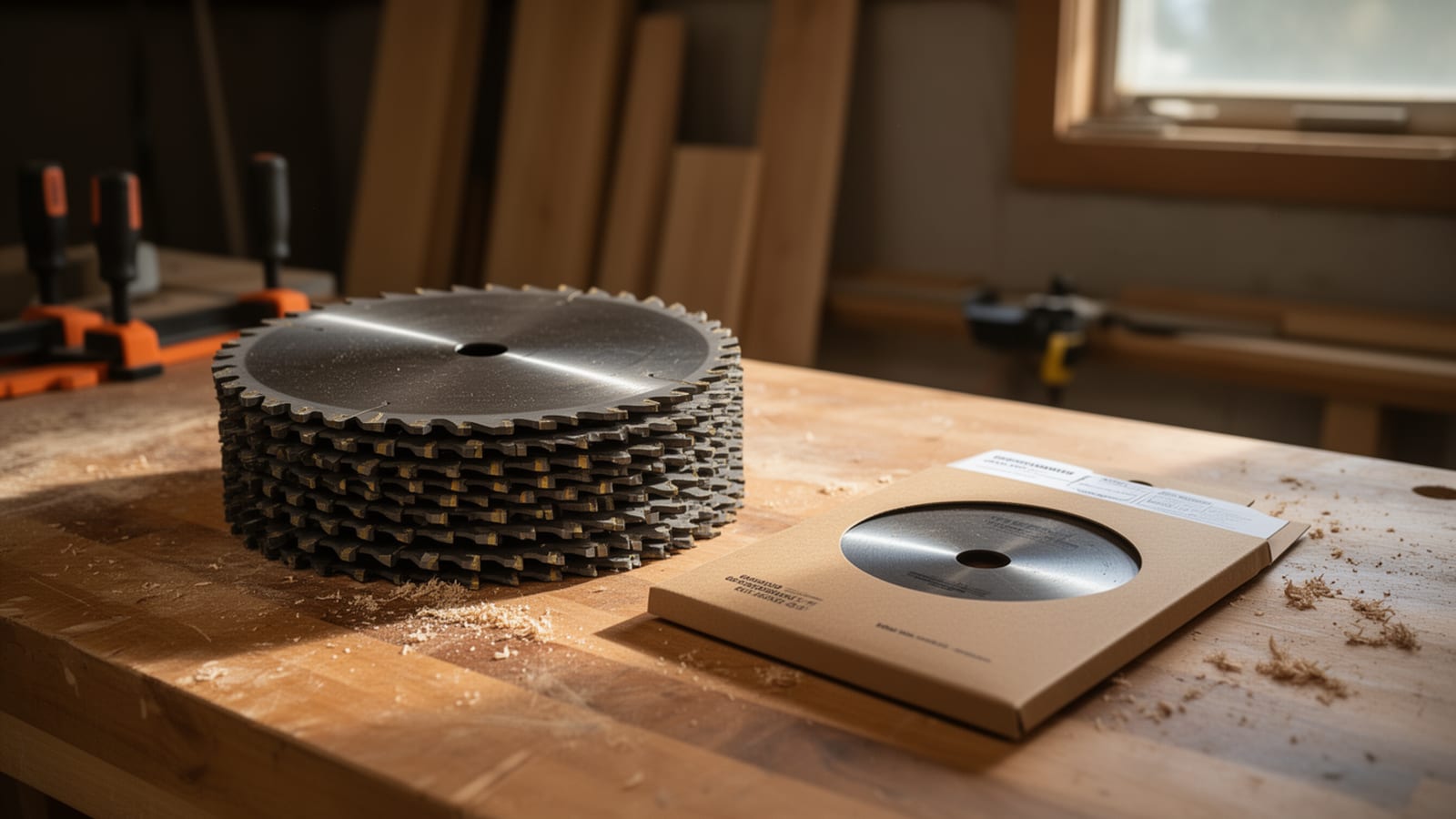
Blade Sharpening Costs vs New Blade Prices: Real Numbers on When Sharpening Pays - A step into the workshop.
Stop Wasting Wood
Generate clear cut diagrams instantly with our new Cutlist Optimizer. Plan your cuts to make your next build easier.
Yo, let me tell you a story. My 40T combo blade started tearing out plywood edges so bad my neighbour knocked on the wall to ask if I was "renovating again." I sat in my second-bedroom shop, which is also where my landlord thinks guests sleep, and did what any New Yorker does before spending money: I price-shopped. Blade sharpening versus a new blade. I figured sharpening was the scrappy move. The math said otherwise. Sit down, because the numbers are rude.
The Sticker Shock Is the Sharpening Bill
Here's the tier pricing from Ridge Carbide Tool, a sharpening service out of South Hutchinson, Kansas. Up to 12 teeth runs $16, 13–24 teeth is $19, 25–40 teeth is $20, 41–60 teeth is $23, 61–80 teeth is $26. A 40T blade, the workhorse most of us leave in the saw, costs $20 to sharpen.
But that's not the number that matters. The number that matters is round trip. Ridge Carbide charges $13 return shipping for the first blade. So one 40T blade, sharpened and mailed back to your door, is $33.
Forrest Manufacturing's factory service is pricier: $32 for a 32–40 tooth blade through 12", $39 for 62–80 teeth, plus $16 return shipping on the first 10" blade. That's $48 all-in for one 40T blade. Forty-eight dollars. For sharpening.
And the budget end? Dynamic Saw in Buffalo, NY charges $11 to sharpen a 6–40 tooth blade, with tip replacement at $3.25. Sounds great, except they don't publish shipping costs, and shipping both ways is on you. Two services publishing return charges run $13 to $16 for a single blade, so I'm not getting excited about the $11 until I know what it costs to get the blade to Buffalo from Brooklyn.
Run It Against a New Blade
The Woodsmith Store in Des Moines lists the Diablo D1040X, a 10" 40T thin-kerf combination blade, at $37.49. Thin kerf, 0.098", ATB, TiCo carbide.
Now do the math. Sharpening that blade at Ridge Carbide costs $33 round trip. That's about 88% of a brand-new blade. And you waited, typically, five business days for the privilege. At Forrest's own service, $48 round trip is more than a new Diablo costs. You'd be paying a premium to keep the old blade.
That's the whole story right there: on a budget blade, sharpening loses. Every time. Unless you're bundling.
The Bundle Is Where Sharpening Gets Interesting
Both services amortize shipping when you ship more than one blade. Ridge Carbide charges $13 for the first blade and $1 for each additional, up to four blades. Forrest is $16 for the first 10" blade, $3 for the second, $2 each after that.
So say you've got three dull blades sitting in a shoebox under the bench, which, real talk, I do. Three 40T blades at Ridge Carbide: $60 in sharpening plus $15 in shipping, $75 total. Twenty-five bucks a blade, all-in. Now sharpening beats a $37.49 replacement. If you've got a stash, bundle it. One blade in a box is a bad trade; three or four changes the game.
You can even buy their shipping box. Ridge Carbide sells a 10" replacement box for $2.50. Small thing, but it tells you they've thought about how this ships.
Premium Blades Flip the Equation
The Forrest Woodworker II, 10" 40T full kerf, 0.094" plate, "double-hard" carbide, lists at $234 direct from Forrest. Sharpen it through Forrest's own service and you're paying $48 round trip, about 21% of replacement cost.
Run it further. Three sharpenings at $48 each is $144. Four is $192. Still under one new $234 blade. That's where sharpening actually wins, and it's not close. The break-even line sits somewhere north of $50 to $60 for blade replacement cost. Below that, replace. Above it, sharpen.
Forrest also claims the extra-thick carbide teeth tolerate more sharpenings over the blade's life. That's their marketing talking, not an independent test, but it's the entire logic of buying a premium blade: the blade is an investment and sharpening is the maintenance line item. On a $37 Diablo, the maintenance costs almost as much as the asset.
One honest caveat: I couldn't verify how many times any blade can actually be re-sharpened. The "3 to 4 times" figure floats around, but no source I could check pins it down. So treat the lifetime math as directional, not gospel.
Small Print That Bites
Read the repair schedules before you send anything. Forrest charges $9 per replacement tip, $17 minimum to straighten a plate, $3.50 per bent tooth, $8 extra grind for an extremely dull blade, even $4 for a test cut. Ridge Carbide charges $7 for tip replacement. Dull out a blade badly enough and your $33 sharpening quietly becomes a $60 repair.
Also: both Ridge Carbide and Forrest say blades deemed uneconomical, too many missing teeth, tips ground too short, broken shoulders, may be scrapped and recycled and will not be returned. You mail off your blade and might never see it again. On a cheap blade, shrug. On a $234 Woodworker II, that's a real risk to think about.
Turnaround differs too. Ridge Carbide quotes about five business days typical. Forrest allows about two weeks on repairs. If your saw is your only saw, two weeks of no table saw is its own cost.
Oh, and Ridge Carbide warns customers against FedEx to their area and recommends UPS or USPS. Detail, but the kind of detail that saves you a lost blade.
Thin Kerf Changes the Sharpening Picture Too
James Hamilton over at Stumpy Nubs points out that thin-kerf blades run roughly 25% thinner kerf, with a plate about 33% thinner than full-kerf. Thinner plates are more prone to heat distortion and vibration, especially in thick hardwood and rips. His take: most pros run full-kerf 40–50T combination blades and switch to a full-kerf 24T rip blade for heavy cuts.
Connect that to sharpening. A premium full-kerf blade like the Woodworker II has more carbide on each tooth, which is exactly what Forrest's "extra-thick teeth" marketing leans on. More carbide means more material for the grinder to work through over the blade's life. That's a manufacturer claim, not a measured fact, but the logic tracks. And a cheap thin-kerf blade has less metal to give, and at $33 a sharpening cycle, it gives up fast.
Just don't expect it to be a long-term sharpening candidate. Buy it, run it, replace it.
My Verdict
Here's the decision rule I came out with. If your blade costs under about $50 to replace, don't sharpen it. Replace it when it's dull. The Diablo D1040X at $37.49 is basically a consumable, and sharpening economics agree. If you're running premium steel, a $234 Woodworker II or anything in that class, sharpening is absolutely the move, and shipping two or three blades together makes the per-blade cost genuinely reasonable.
And a middle note: the Freud LU83R010 10" 50T thin-kerf combination blade sells for $69.26 on sale at Tool Nut, list $80.97. That's right at the murky line. At $23 to sharpen through Ridge Carbide (it's in the 41–60 tooth tier), $36 round trip, you're spending about half of replacement per cycle. Defensible, especially if you bundle.
For me, apartment shop, one blade in rotation, one blade dulled at a time? The cheap blade gets replaced, and when I finally upgrade to premium steel, I'll build up a two-blade stash before I mail anything. Bundling is the only way shipping math stops insulting you.
Check your own blade prices, check the sharpening tier, add the return shipping, and be honest about how many blades you'll actually send at once. The answer's in the arithmetic, not the folklore.