
Pin vs. Pinless Moisture Meters Under $150: Where Budget Meters Fail Woodworkers
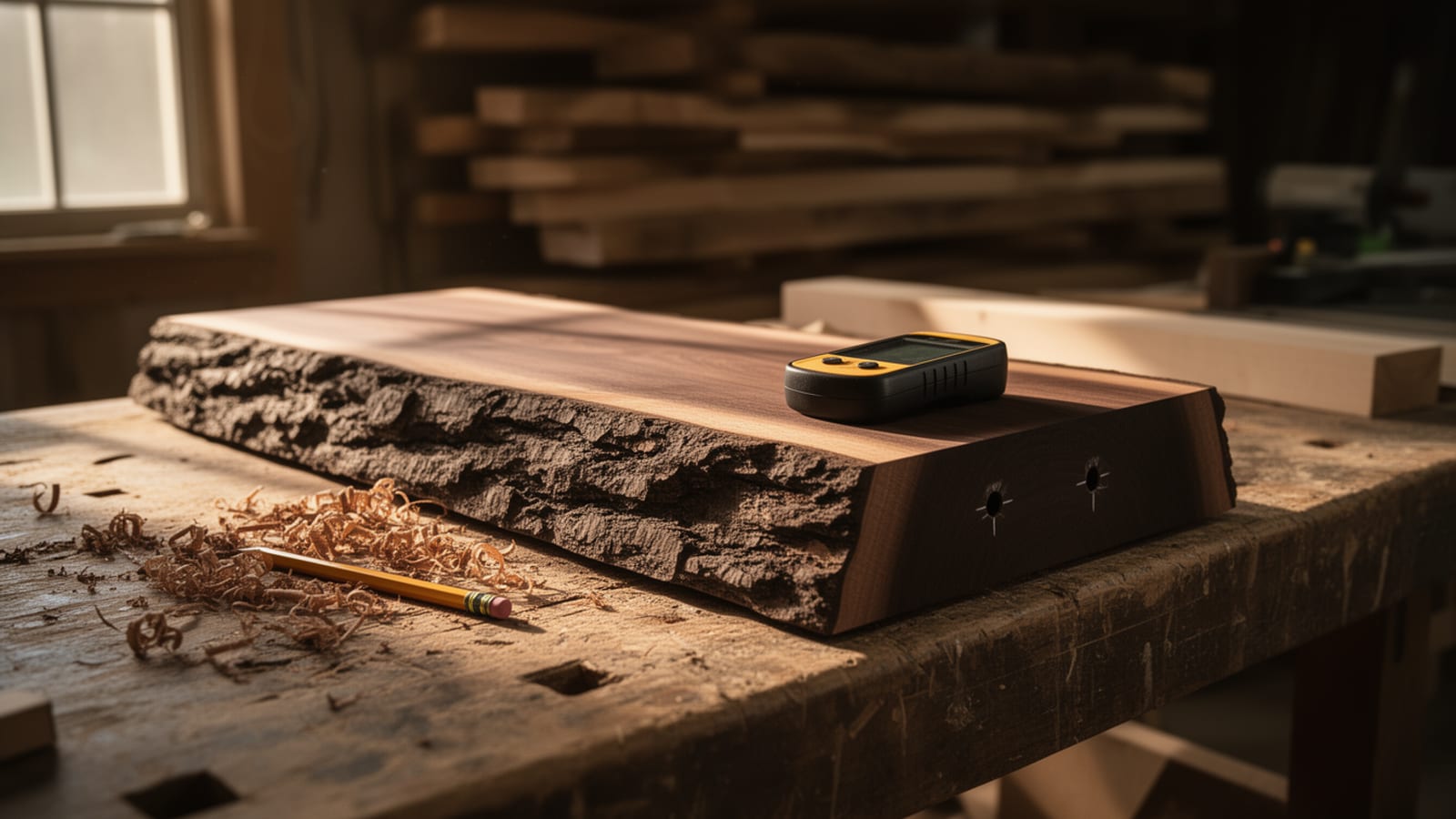
Pin vs. Pinless Moisture Meters Under $150: Where Budget Meters Fail Woodworkers - A step into the workshop.
Stop Wasting Wood
Generate clear cut diagrams instantly with our new Cutlist Optimizer. Plan your cuts to make your next build easier.
Yo, let me tell you a story. Last fall I'm hauling a walnut slab home from a stoop in Crown Heights. Somebody's grandfather's project, free on the curb, rough-sawn, three inches thick. I get it upstairs, my landlord hears the thumping, and I'm already picturing the coffee table. Then I stick my cheap pin meter in the side and it says 12%. Great. Build it.
Except I had a nagging feeling. Three-inch walnut and a meter with pins the length of a thumbtack? That 12% was a lie, and the kind of lie that shows up six months later as a warped apron on a finished table.
So let's talk about what budget meters under $150 actually read, and where they break down.
Two Technologies, Two Different Lies
First, the basics, because the lies are different.
A pin meter pushes two metal pins into the wood and measures electrical resistance between them. Drier wood resists more current. The catch: species chemistry messes with resistance, which is why correction tables exist (Wagner Meters). And the reading only covers the tiny sliver of wood between the pin tips. One point. One reading. Want to know what a whole board is doing? Take a bunch of readings.
A pinless meter has a sensor pad you press against the surface. It senses electromagnetically and is affected by specific gravity — density — instead of chemistry (Wagner Meters; Delmhorst). It scans a wide swath per reading, so checking a whole board is way faster. The catch: it reads at a fixed depth, typically a 1/4" shallow setting or a 3/4" deep setting on quality meters, and it needs flat, firm contact. On cheaper pinless meters, even hand position can shift readings (Wagner Meters).
Every pin reading leaves two holes. Pins bend or snap in dense hardwoods, and if you don't have spares, your meter's a paperweight. Ask me about white oak sometime. Actually don't.
The MMD4E's Greatest Hits of Lying
Here's the part that should scare you. Moisture Meter Experts tested the General Tools MMD4E, a budget pin meter with a stated wood range of 5%–50%. Their findings:
- Accuracy was only reasonable between 10% and 15% moisture content. Below 10%, many readings showed as flat zero. Above about 17%, readings leveled off and stopped climbing.
- Their verdict on that flaw: it "renders the meter unsuitable for flooring applications and furniture making." They scored its accuracy 2.9 out of 5.
- Surface moisture inflated readings by over 19%. Condensation or a humid-shop morning on the board face and your "reading" is mostly the weather, not the wood.
- The meter reads 1.3% low when cold and 3% high when warm.
- No species selection at all — the manual literally tells you to develop your own correction curves. And the pins broke during testing.
Read that first bullet again, because it's the whole game. In the zone below 10% where a lot of finished-wood readings land, many readings from this meter show as flat zero, and above about 17% it pins the needle and stops. At the numbers that actually matter to a woodworker, the thing lies.
Resolution Is Not Accuracy
Now the pinless side. Dr.meter's MD918 lists on their own site at $56.99, with a 4%–80% range. The headline spec says "Accuracy: 0.5%." Sounds precise, right?
Flip to the full spec and the real number is max error of 1%RH plus 0.5. That headline 0.5% is not the whole story — and Wagner's buying guide calls out exactly this trap: a meter can display tenths of a percent (that's resolution) while being well off the truth (that's accuracy). A cheap meter showing you 7.4% can be confidently wrong.
The MD918 has 10 timber-density settings and only operates between 0 and 70% relative humidity, which in a Brooklyn shop with a radiator going all winter is... fine, actually, but worth knowing. It also wants zero-calibration and temperature calibration after battery changes, first use, or long storage. Skip that and who knows what you're reading.
The most honest independent take I found, from DryHomeGuide, treats the MD918 strictly as a screening and comparison tool — readings get skewed by surface condition, a wrong density setting, and hidden materials underneath, and it "should not be treated as a lab-grade measurement." No independent oven-dry-validated accuracy numbers exist for this model that I could find. That silence is itself information.
The Ground Truth Your Cheap Meter Is Guessing Against
So what would a good meter get right? Here's the reference frame.
Delmhorst, who've been calibrating meters since 1946, base all pin-meter wood calibration on Douglas fir, the USDA standard. Every other species reads differently at the same moisture content and needs correction. Their pinless meters are calibrated at specific gravity 0.46. Look at the species on their published table: white oak 0.60, hard maple 0.56, black walnut 0.51, Douglas fir 0.45, white pine 0.36, western red cedar 0.31, jatoba 0.77. That's a spread from 0.31 to 0.77. A meter calibrated mid-range will read one species high and another low if you don't correct — and budget meters make you do the correcting yourself, by hand, from a table, or not at all.
Temperature matters too. Delmhorst's correction table says no correction is needed between 50°F and 90°F, but at 20°F a reading of 20% corresponds to roughly 28% true moisture content. Even pin type matters: insulated pins read lower than non-insulated — a 14% insulated reading corrects to 14.9%.
And here's the one for my slab situation. The USDA guideline, as cited by the Moisture Meter Experts reviewer: read boards at a depth of one-fourth to one-fifth of their thickness. My three-inch walnut wants pins driven about half an inch-plus deep. The built-in pins on a budget meter can't get anywhere near that. You're reading the surface shell of a thick board, and the shell dries first. That 12% was the outside of the board lying about the inside.
What "Good" Actually Costs
For scale: Wagner claims their Orion pinless meters hold error to less than ±1.25% MC over a 50-sample oven-dry study in the 6%–10% range, used correctly. That's the benchmark. The MMD4E, below 10% MC, shows flat zero on many readings. You're not choosing between two imperfect tools; one of them works where it counts and one doesn't.
Fine Woodworking's review (way back in 2010, so take the models and prices as history) came down like this: pin meters are "ultimately more accurate" for pinning down the exact moisture at a specific spot, best if you dry your own lumber or work thick stock and accept the holes. But they judged pinless meters more appropriate for most home-shop woodworkers. In a small shop scanning whole boards fast, without punching holes in finished surfaces, that tracks with my experience.
The Real Move: Trust the Oven, Not the Box
The reference standard for all of this is oven-dry testing: cut a small section off the board, weigh it, dry it, reweigh it to constant weight. Fine Woodworking notes it takes a couple of days. It's destructive and slow, which is exactly why meters exist — but it's the yardstick. Wagner's own guidance says meter accuracy should be validated against oven-dry testing.
Here's my takeaway for the constrained shop. If you're buying under $150, buy the pinless meter for speed and whole-board scanning, learn its density settings cold, and treat it as a screener — the tool that tells you which board to check next. Then, before you commit a slab to a build, actually run the oven-dry test on a cutoff. Costs you a scrap and two days. Compare what your meter said against what the oven said. Now you know your meter's personal lie factor, on your species, in your shop.
Because every cheap meter lies a little. The trick isn't finding one that doesn't. It's knowing exactly how yours does.
That walnut slab, by the way, sat stickered behind my couch for another four months. The second round of readings came down two points. Worth the wait. Barely.