
Sharpening Consumables Compared: Diamond Plates, Waterstones, Oil Stones, Scary Sharp
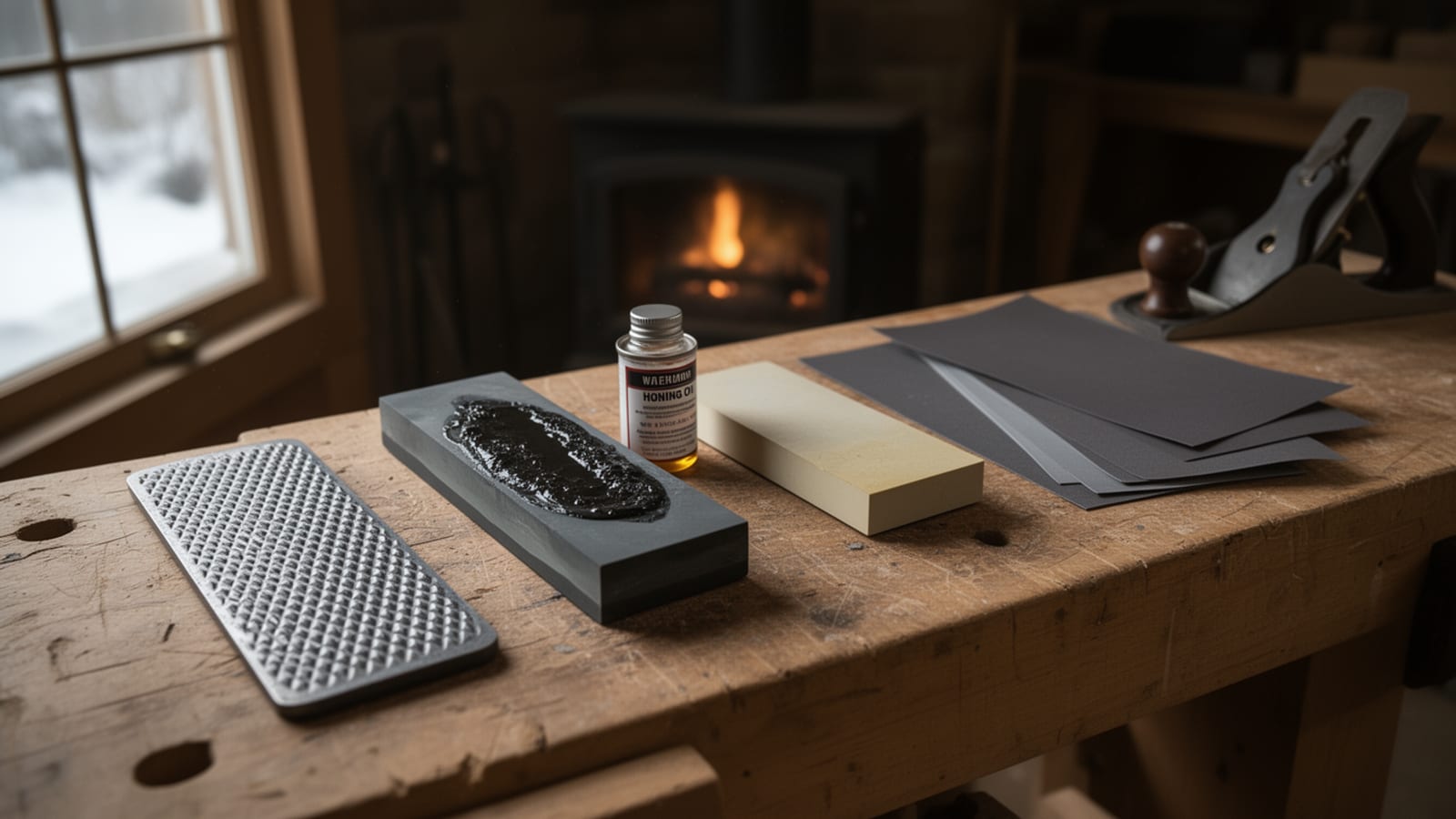
Sharpening Consumables Compared: Diamond Plates, Waterstones, Oil Stones, Scary Sharp - A step into the workshop.
Stop Wasting Wood
Generate clear cut diagrams instantly with our new Cutlist Optimizer. Plan your cuts to make your next build easier.
The Ledger on the Bench
February in Vermont, and the frost is still holding the ground outside my shop like a vise. Inside, the woodstove has taken the edge off the air, and a No. 4 sits on the bench with an iron gone dull enough to skate across pine instead of bite it. Sharpening day. And sharpening day, if you're honest about it, is also spending day — every edge you hone wears something down, and whatever that something is, you bought it, and you'll buy it again.
Most sharpening arguments are arguments about feel: this stone glides, that plate cuts fast, the other leaves a prettier polish. Fine. But I wanted to know a harder thing. Over five years of honing one plane iron and a set of bench chisels, what does each system actually cost per edge? Not the sticker price at the register — the slow, recurring bill of consumables: flattening stones, lapping grit, sheets of paper, the wear on the media itself.
What follows is arithmetic, not gospel. I'll show the prices, which are verifiable, and I'll show my assumptions, which are mine alone, because no manufacturer on earth will tell you how many edges a stone yields. Anybody who quotes you a cost per edge without showing their assumptions is selling something.
One Scale to Compare Them
The trap in any sharpening comparison is that grit numbers lie. Christopher Schwarz made this point in Popular Woodworking's "True Grit" piece, and it's the foundation of everything below: numbers are not comparable across systems. A #1,000-grit waterstone is not the same as #1,000-grit sandpaper, and even sandpaper numbers differ between US and European standards. The only honest common currency is the micron — the actual particle size doing the cutting.
Sharpening Supplies' own grit chart maps this out across ten levels, from extremely coarse (over 100 microns, under 150 grit) down to mirror finishes (0–2 microns, 10,000 grit and finer). Once you convert, some curious facts surface. Schwarz's worked example: a soft Arkansas oilstone and an extra-fine India stone are both around 22 microns. Stepping from one to the other gains you nothing — you're paying for a second stone that cuts like the first.
So the map for our purposes: Atoma 140 at 88–105 microns for repair and flattening duty; Atoma 1200 at 10–20 microns for finishing; fine Norton India oil stones sitting near 22 microns; the Norton 8000 waterstone and Shapton 16000 up in the near-mirror band. Four systems, one ladder. Now the money.
Diamond Plates: Expensive Door, Cheap Hallway
Atoma plates run $109.99 each at Sharpening Supplies, in 140, 400, 600, and 1200 grit. A sensible three-plate woodworking set in the 400/600/1200 neighborhood is, by my arithmetic, roughly $330 up front. That stings. It is the most expensive door into any of these rooms.
But look at the construction and the shape of the costs after that. Each plate is a 1 mm stainless sheet carrying precision-placed monocrystalline diamonds, bonded to a 10 mm precision-flattened aluminum base, 210 by 75 mm. Crucially, the diamond sheets are replaceable — the aluminum base is a one-time purchase and the sheet is the recurring line item. (I could not retrieve the replacement-sheet price as I write this; the collection page was down. So the honest version of this column reads: high capital, then a sheet-replacement cost I can't yet price, and no flattening consumable at all.)
That last part matters. The channels between diamond clusters let waste collect so the plate keeps cutting without clogging — there's no dishing, no truing, no lapping grit bought year after year. The plate is the system that front-loads its bill and then goes quiet.
Waterstones: Fast Cut, Recurring Flattening Bill
Norton's Water Stone Kit — a 220/1000 combination stone, a 4000/8000 combination stone, and a flattening stone, all 8 by 3 inches — lists at $219.35 at Sharpening Supplies. The Shapton GlassStone 500/2000/16000 set, part 50408, runs $229.50, marked down 25 percent from $306. Either is a mid-range entry, and the Shapton GlassStone HC series, designed specifically for high-carbon steel like our plane iron and chisels, runs $76.50 to $101.70 per stone if you'd rather buy one at a time.
Here's where the ledger gets interesting. Norton's own description concedes the structural truth: waterstones wear faster than harder oil stones, though the stones will last years, even decades, for most users. The softness that makes them cut fast also makes them dish. Dishing means flattening, and flattening means consumables.
If the Norton kit includes a flattening stone, your recurring flattening cost is modest at first. Shapton's options tell the fuller story of what flattening can run: a Diamond Lapping Plate at $341.10, a compact plate at $121.00, or the Naoru cast iron lapping system at $219.99 — which uses loose Surfacing Compounds at $22 to $29 apiece that are genuinely recurring purchases. There's also a simple 120-grit lapping disc at $25.50, consumable by design. You can keep the flattening bill small with the disc, or buy your way out of dishing complaints with the plate. Either way, waterstones are the one system where flattening is a permanent line in the budget, because the stone's softness is not a defect — it's the mechanism.
Oil Stones: The Cheapest Stones and the 22-Micron Ceiling
Norton India bench stones, 8 by 3 inches, are $28.99 per grit, or $78.99 for all three — coarse, medium, and fine aluminum oxide. That is, by a wide margin, the lowest verified stone cost of the four systems. The two-sided India combination stone is $36.49; the Crystolon–India combination, with fast-cutting silicon carbide on one face, is $89.99. The stones barely dish. Flattening is, for practical purposes, not a line item.
The consumables look different. Oil stones take honing oil — the one recurring cost the other three systems don't carry. I couldn't verify a street price for honing oil while researching this, so I won't quote one; I'll say only that it's real, small, and perpetual, like the creosote on a fence.
The other cost is subtler, and it comes from Schwarz's micron math. Fine India tops out around 22 microns — the same as a soft Arkansas. Below that ceiling, an oil stone alone cannot take you; you'll want a strop with compound or a finishing medium of another kind to reach the near-mirror territory the Norton 8000 or Shapton 16000 reach natively. So the oil-stone column reads: least money for stones, a small oil bill, and either a ceiling you accept or a small second purchase that quietly erodes the price advantage. For a workbench iron that spends its life in pine and poplar, 22 microns may honestly be enough. Only your hands can answer that.
Scary Sharp: Almost No Capital, A Paper Bill on Every Edge
The method is almost embarrassingly simple: adhesive-backed wet/dry sandpaper on a dead-flat slab of glass or granite, working up through the grits. The 3M Wetordry 03006 line comes in assorted packs of 1000/1500/2000/2500 grit, sheets of 3-2/3 by 9 inches, five to a pack. Capital cost approaches zero — a substrate and some paper. (I could not verify a price for either the packs or the substrate, so I won't invent one.)
The economics are the mirror image of the plates: nothing up front, and a consumable on literally every edge. Every honing session eats paper. Woodworkers on the Sawmill Creek forums have reported roughly $35 buying a large stash of sheets — a hobbyist's number from 2007, worth hearing as color but not as data. The same forum holds a claim that 3M's diamond lapping films cost about 15 percent of what a diamond plate does per unit area, with very uniform particle size. Again: forum talk, not fact. But the structural point survives all caveats — Scary Sharp trades capital for a recurring paper bill, and the bill arrives on schedule with every dulled iron, forever.
The Assumptions, Laid Bare
Here is what I cannot give you and nobody could: a verified figure for edges per stone, sheets per edge, or strokes before a waterstone dishes. No manufacturer or retailer publishes wear rates. Anyone who says otherwise is extrapolating.
So take my assumptions as assumptions. If a plate lasts five years under shop use with no flattening cost, its five-year bill is the purchase price plus sheet replacements. If a waterstone set needs periodic truing and the occasional compound, its bill grows modestly but never stops. If an oil stone barely wears but caps you at 22 microns, its bill is nearly flat and so, arguably, is your edge. And if every Scary Sharp session consumes paper, its bill is small each time and infinite in installments.
My judgment, for what it's worth and clearly as opinion: for a shop like mine — a No. 4, a set of bench chisels, edges to maintain through a Vermont winter — the diamond plates buy their way out of the recurring flattening bill, and that appeals to me the way a well-fitted lid appeals to a good box. Oil stones are the honest cheap route if 22 microns suits your work. Waterstones reward those who love the feel and accept the truing. Scary Sharp remains the finest way I know to find out whether you actually like sharpening before spending real money.