
Woodshop Lighting Guide: 4000K vs 5000K, CRI and R9, and Lumens for a Two-Car Garage
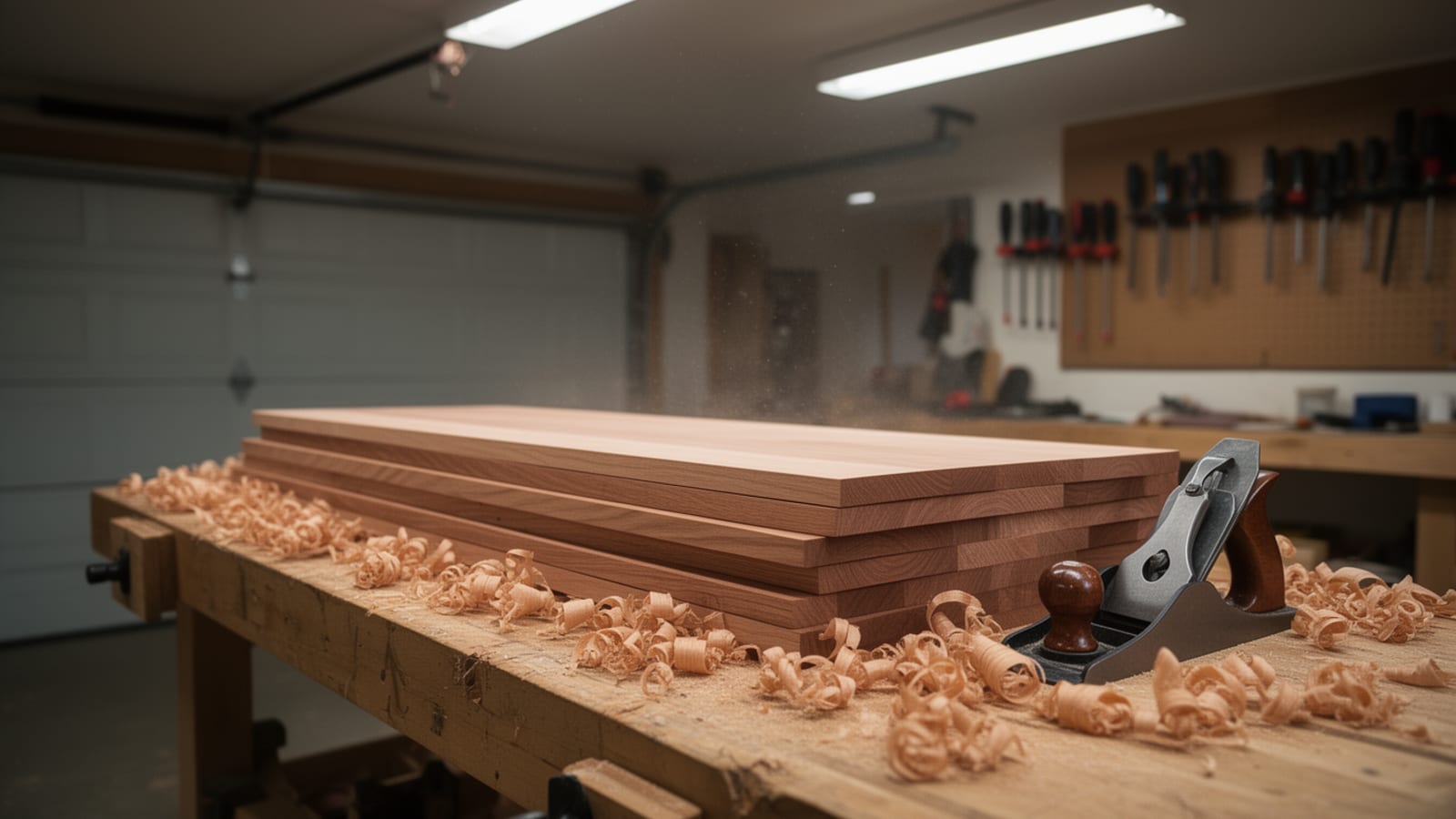
Woodshop Lighting Guide: 4000K vs 5000K, CRI and R9, and Lumens for a Two-Car Garage - A step into the workshop.
Stop Wasting Wood
Generate clear cut diagrams instantly with our new Cutlist Optimizer. Plan your cuts to make your next build easier.
Last winter I finished a cherry keepsake box for my sister's birthday, sanding by the three cheap LED strips I'd hung from the garage ceiling years ago. It looked fine in the shop. Then I carried it into the kitchen, under our warm 2700K bulbs, and the whole thing shifted color on me. The finish wasn't wrong. The light had been lying.
If you've ever had that moment, you've probably gone down the same rabbit hole I did: shop lighting advice, and the internet cannot agree on it. One lighting vendor insists 4000K is the professional benchmark for woodworking. Another workshop-testing site says default to 5000K "daylight" over your main bench. A third vendor recommends 6500K. That's a 2500K spread of confident opinions. After sorting through what these sources actually say, I think the argument itself is the distraction. Let me show you why.
The Color Temperature Fight Nobody Wins
Here are the positions, stated fairly. Hyperlite, a vendor of high-bay LED fixtures, argues that 5000K adds a subtle blue cast that masks the yellow and red undertones in species like cherry, walnut, and mahogany, and pushes 4000K as the woodworking choice. Workbench Test Lab, a workshop-testing site, takes the opposite view: 5000K mimics daylight and is how customers will ultimately view a finished piece, so they say default to 5000K with CRI 90+ over your primary stations. HEXLED Lighting goes further still and recommends 6500K as the working-shop default.
Three sources, three answers. But read them closely and something interesting happens: all three concede the same point. Hyperlite admits 5000K is "better for pure color matching" but can feel sterile. HEXLED says outright that CRI and uniformity, not color temperature, are what actually make fine work easier. Workbench Test Lab says CRI and placement are the real variables. When the loudest advocates of each position all agree the metric you're arguing about matters least, that's your answer.
Worth naming too: both Hyperlite and HEXLED sell fixtures. They cite genuine standards, like ANSI C78.377-2017, which is the chromaticity standard that makes a "4000K" fixture from one manufacturer reasonably match another's. But the color temperature recommendations themselves are editorial. So my advice: anything from 4000K to 5000K is a defensible choice for a woodshop, and if you want to stop worrying about it entirely, CCT-selectable fixtures let you flip between them. Spend your decision-making energy elsewhere.
The Number That Actually Matters: R9
Here's the metric most of us never heard of. CRI, the color rendering index you see on the box, averages eight pastel test patches. R9 is a separate score measuring how faithfully a light renders saturated red. And red is exactly where wood lives. Low R9 desaturates cherry, mahogany, walnut, cedar, and ash tones.
Workbench Test Lab characterizes it this way: most 80-CRI sources have an R9 value around 0, most 90-CRI sources run R9 around 50, and most 95-CRI sources around 90. Those are their figures, not an official published table, but the direction is consistent with what Hyperlite says independently: they call R9 above 90 a structural requirement for accurate grain inspection and stain matching, and describe a "cyan gap" in typical 80-CRI LEDs that makes walnut read grey and muddy while cherry loses its warmth. In plain terms: an 80-CRI shop light will lie to you about stained cherry. Ask me how I know.
Workbench Test Lab also notes that R9 often isn't published, but manufacturers will provide it if you ask. So ask.
There's a budget angle here too. Workbench Test Lab publishes a zone-by-zone CRI table and argues that 95+ CRI everywhere is wasted money, because higher CRI costs you lumens per watt. That's physics, not marketing. Their guidance: 90 CRI with good placement is the optimal operating point, with 95 reserved for detail work like the vise station, 90–95 at stain and finish application, and 80 CRI fine over rough milling, outfeed, and the tool-maintenance bench. Spend the CRI where you're looking at wood closely.
How Much Light You Actually Need
Now the numbers that decide how many fixtures you buy. Lighting standards are written in footcandles (one lumen landing on one square foot), but manufacturers advertise fixture lumens, and the gap between the two is where most online advice falls apart.
The IES-derived guidance, as cited by HEXLED and Hyperlite, calls for 50–100 footcandles for medium bench and machine work, and 200–500 for fine bench work like sanding and finishing, with the important IES footnote that the top range assumes general light plus supplementary task lighting. General workshop light sits around 30–75 fc. For contrast, OSHA's minimum for a construction-site carpenter shop is only 10 fc, which tells you a regulatory floor is not a lighting plan.
Here's the math for a typical two-car garage. Hyperlite works a 22×22 ft example, 484 square feet, targeting 50 fc. Baseline: 484 × 50 = 24,200 lumens. Then divide by a light loss factor of about 0.80 to account for dust and lumen depreciation, because sawdust on lenses is very much the woodshop version of this problem. That lands at roughly 30,250 fixture lumens.
HEXLED runs the same exercise differently, targeting the top of the bench-work band at 75–100 fc in a 400-square-foot bay, with a 0.55 delivery factor. Their answer: 135–180 lumens per square foot, or 54,000–72,000 fixture lumens. The two sources disagree because they're aiming at different targets and using different multipliers, but the reconciliation is useful. Around 30,000 lumens gets a two-car shop to a functional 50 fc. Roughly 55,000–72,000 gets you to serious, finishing-grade 75–100 fc.
And if you're wondering whether the three strips already hanging in your garage are enough: HEXLED's math says three typical 4-foot LED strips, at 12,000–15,000 fixture lumens across 400 square feet, deliver only about 17–21 fc at the bench. Under half the medium-bench minimum. That's the quiet reason my finish looked different in the kitchen. It wasn't just color, it was never bright enough to judge properly.
Layout Beats Brute Force
Don't solve darkness with one giant fixture. Hyperlite simulated a 750 sq ft shop and found four 20,000-lumen fixtures produced a 4.2:1 max-to-min uniformity ratio, meaning shadows in the corners, while six fixtures of 14,000–15,000 lumens in a 3×2 grid achieved an excellent 1.8:1. Just spread out.
A few layout rules worth following:
- Spacing: aim for a spacing-to-mounting-height ratio between 1:1 and 1.5:1. At a 12-foot ceiling, that's fixtures 10–14 feet apart. Under 10-foot ceilings, use linear strips in continuous rows rather than concentrated point sources, which glare.
- Overlap: Hyperlite recommends beam patterns overlap 30–40% at the working plane, about 36 inches off the floor, so your own body doesn't cast a shadow on every glue-up.
- Uniformity: the IES-derived rule is that the dimmest point should be at least two-thirds of the average. If one corner of the shop is noticeably darker, you'll unconsciously avoid working there.
- Task light: Workbench Test Lab recommends mounting fixtures at 45 degrees to the work surface, since directly overhead light hides detail under your joinery. For a 4×8 assembly table, that's one 4-foot linear fixture per long side, 3–4 feet above the surface, plus a narrow fixture over the vise.
What I'd Actually Buy
On price, the honest answer is that good data is thin. Barrina's storefront, fetched recently, lists their 4-foot 84W 10,000-lumen 5000K shop lights from $39.99 (a listed sale price, and worth treating skeptically) and 8-foot 168W 16,800-lumen units from $139.99. That's a real fixture cost for a mid-lumen strip.
Two telling details while shopping. First, Hyperlite advises distrusting any fixture whose manufacturer can't produce a third-party LM-79 report, the IES standard for measuring an LED's actual lumens, wattage, and CRI. Second, their certification checklist is worth keeping on your phone: UL 1598 for luminaire safety, which matters in a dusty shop, IP65 for dust-tightness, FCC Part 15 to guard against driver flicker, because flicker can make a spinning saw blade appear stationary, plus a 5-year warranty and downloadable .ies photometric files.
And a small aside that made me smile: Barrina currently lists 53 shop-light models, 22 of them in 5000K and exactly 2 in 4000K. Whatever the CCT debate says, the market has voted.
From My Workshop to Yours
Here's my plan, and I'd suggest you steal it. Stop agonizing over 4000K versus 5000K; pick either, or buy selectable. Put your money into CRI 90 or better with verified R9 over the bench and finishing station, and leave cheap 80-CRI strips over the rough-milling zone where they'll do fine. Get to at least 30,000 fixture lumens in a two-car garage, more if finishing is your thing, and spread fixtures out rather than clustering them. Add one good task light at 45 degrees over your assembly table.
Then wipe the sawdust off the lenses once a quarter. HEXLED notes that a season of dust creates a yellow haze over even the best layout, and I'd rather not relearn that lesson the hard way. My sister's box, for the record, looked lovely in daylight. Next time I'd like to know that before the glue sets.