
Finishing Small Gifts: Shellac Flakes vs Canned vs Aerosol vs Wipe-On Poly, Per Piece
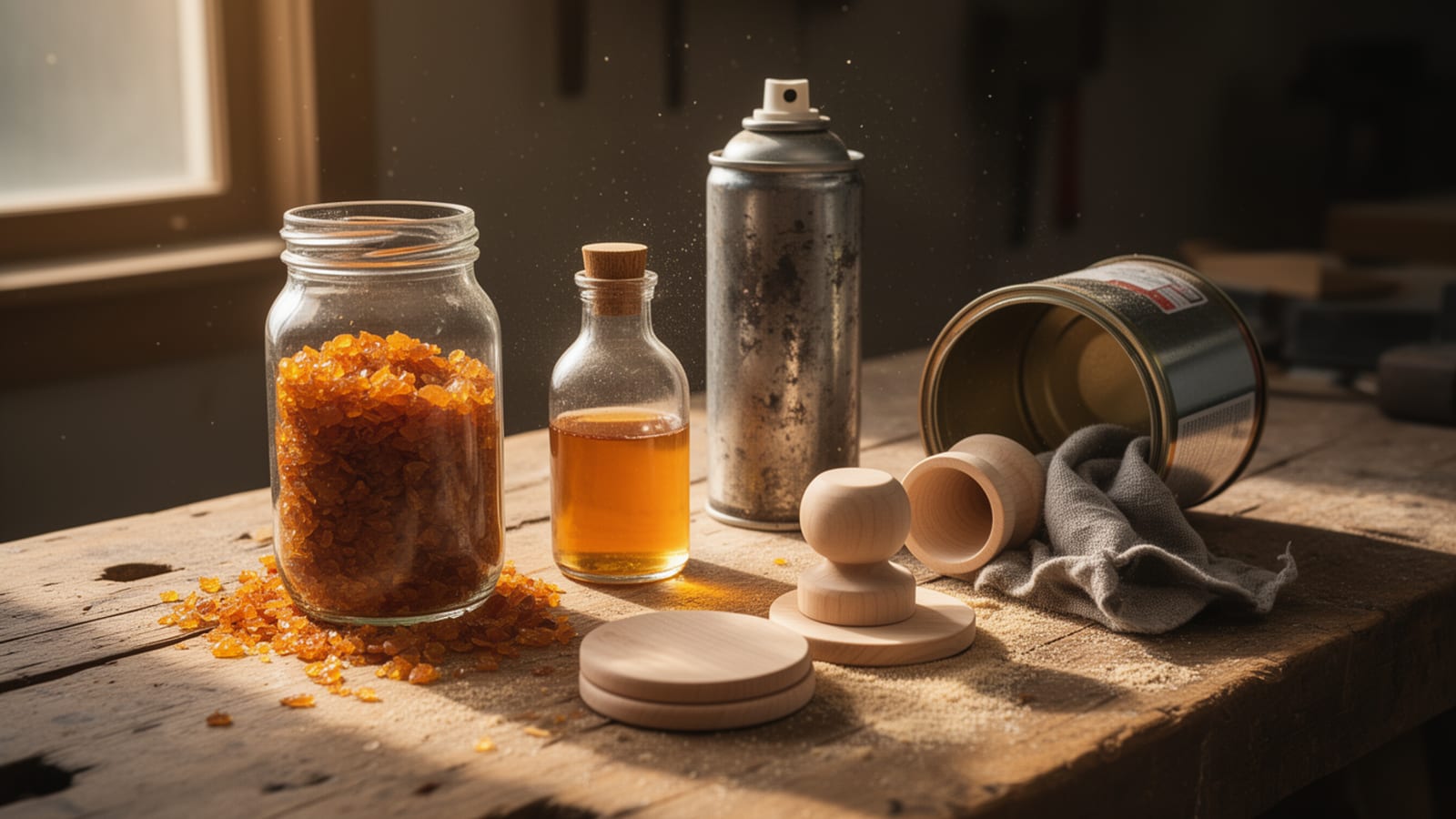
Finishing Small Gifts: Shellac Flakes vs Canned vs Aerosol vs Wipe-On Poly, Per Piece - A step into the workshop.
Stop Wasting Wood
Generate clear cut diagrams instantly with our new Cutlist Optimizer. Plan your cuts to make your next build easier.
We've all been there: the gift is done. The box is sanded to 320, the coasters are stacked and ready, the small turning finally came off the lathe without a catch. And then you're standing in the shop at 8:40 p.m., a kid asking what's for dinner, staring at the finish shelf and thinking, "Which one of these do I actually use, and what does it cost me per piece?"
Finishing is the step where small-batch gift economics get quietly weird. Materials cost almost nothing per piece if you brush from a quart, and yet a $15 aerosol can somehow disappears after five ornaments. And if you turn, there's the glue-block problem: whatever you attached the waste block with, the bottom face only exists as a finishable surface after the piece comes off the lathe. So the finish has to be fast, wipe- or spray-applied, and forgiving. Let's walk the four realistic options and do the math.
First, the Glue-Block Problem Sets the Rules
If you turn gifts, the finish system has to handle a bottom face you can only reach after parting off. The turners on the American Association of Woodturners forum describe the classic methods: hot-melt glue and double-sided tape, thick CA glue spread over the whole waste-block face (it sets in minutes, works on wet wood, and breaks free with a flat chisel), or a clever paper joint, where you glue the waste block on over kraft paper and part it off with a thin putty knife right in the paper line.
Either way, the bottom gets finished last, off the lathe, often in the same session. That's why brushed builds and slow-curing varnishes fight you here.
Shellac Flakes: The Math of Mixing Fresh
Pound cut is the term of art here: pounds of dry shellac dissolved in one gallon of denatured alcohol. The practical version, per Shellac.net's pound-cut chart, is that 8 dry ounces of flake in one quart of alcohol makes a 2-pound cut, which is the sweet spot for brushing on gift objects.
The whole argument for flakes is freshness. Bob Flexner's oft-cited point, quoted in a Woodworking in a Tiny Shop post, is that shellac starts losing its ability to harden the moment the flakes meet alcohol. Shellac.net tells you to mix only what you'll use within about three months; StewMac, the instrument-finishing folks, treats fresh as a two-to-six-month window before they toss it and mix a new small batch. EngineerFix puts dissolved shellac's practical shelf life at roughly six months to a year, with degradation happening through esterification until the resin simply won't harden properly. Those ceilings don't all agree, so take the conservative end as your working rule.
Here's why that matters for gifts rather than furniture: a quart of 2-lb cut takes only 8 dry ounces of flake. WoodFinishing Enterprises in Milwaukee lists dewaxed orange Indian flake from $8.70 and German dewaxed ultra-light from $22.40. Buy a half-pound of the Indian grade for roughly five dollars, and one purchase covers a whole season of boxes, coasters, and small turnings, mixed fresh each time. Dry flake stores for years, so nothing goes to waste.
What does fresh actually buy you? Practitioners on LumberJocks report that fresh-flake shellac lays out smoother and buffs out easier than canned Zinsser, whose age on the store shelf you can't know. For a gift you're handing to someone, that difference shows up in the final rubbing-out, and it's real.
Canned Shellac: The Trivially Cheap Baseline
A quart of Zinsser Bulls Eye shellac runs $32.99 at Ace Hardware, ready to brush; retailer listings put it at a 3-lb cut. Coverage is in the neighborhood of 100 to 150 square feet per quart per the retailer listings, so a 2-square-foot gift box uses a couple of percent of the can. Call it fifty cents of material per piece. The economics are unarguable.
The weakness isn't price, it's uncertainty. Canned shellac's cure state on arrival is a mystery, and the same practitioner reports bear this out: older canned stock doesn't flow out as nicely and doesn't buff as easily. If you're doing one coat as a sealer under something else, canned is fine and cheap. If the shellac is the finish on a wedding-keepsake box, freshness is worth something.
Rattle Cans: Paying for Speed, Knowingly
The Zinsser 12-ounce shellac aerosol shows at $14.98 at Home Depot, though that price came from search results rather than a page I could verify directly. Coverage figures are contested, which I'll be honest about: Walmart's listing is reported at up to 10 square feet per can, Lowe's says up to 15. Either way, that's five to seven 2-square-foot gift pieces per can, so roughly $2 to $3 of spray per piece. That's four to six times the per-piece material cost of brushing from a quart.
And yet I still reach for them on turnings. Zero setup, zero cleanup, and you can seal the freshly parted-off bottom while the piece sits in a soft jaw or spins in your hand. Shellac's fast dry (the brush-grade dries to touch in about 30 minutes per the retailer listings) means the last face is sealed the same evening. The premium is a convenience fee, and on the night before a birthday, it's a fee I pay without guilt.
One caution: if you go the lacquer-aerosol route, there are matching aerosol sanding sealers out there, but pricing is hard to pin down. The one listing I found, for the Deft 12-ounce sealer at Walmart, was a single $37.89 outlier I wouldn't plan around, so check your local shelf.
Wipe-On Poly: The Patient Option
Minwax Wipe-On Poly is $25.99 a quart at Ace Hardware, covers about 125 square feet, has a 3-hour recoat window, and cleans up with mineral spirits. The directions call for two to three coats and 24 hours before normal use. Do the math on a gift: three coats on a 2-square-foot piece is 6 square feet of coverage, about 5% of the quart, roughly $1.25 in material.
That 24-hour cure is the catch. For a box that needs to be wrapped tomorrow, wipe-on poly doesn't fit the timeline; for a cherry keepsake box you're finishing a week ahead, it's a lovely, forgiving, low-build finish that a beginner can't really ruin. Reviewers like CompositePaint position it squarely as a small-project and furniture finish, which is exactly our use case. It's not for anything going outside, either, since it isn't rated UV resistant.
So What Should You Buy This Weekend?
My take, for what it's worth from my own shop:
- Mostly boxes and boards, batches of gifts per season: a half-pound of dewaxed orange flake from WoodFinishing Enterprises, around five dollars, plus a quart of denatured alcohol. Mix a 2-lb cut fresh before each gift run. Cheapest good finish per piece, and the freshness shows.
- Pale woods where the finish needs to disappear: step up the flake grade. The German dewaxed ultra-light from $22.40 at WoodFinishing Enterprises buys water-white color; Shellac.net's Platina sits at $69.50 a pound for the same reason. That's a premium you only pay when the wood demands it.
- Turnings, ornaments, last-minute anything: the $14.98 aerosol. Accept the $2 to $3 per piece as the price of finishing the glue-block bottom tonight.
- Sealer duty or shop pieces: the $32.99 quart of canned Zinsser. Its age is unknowable, but under another finish, who cares.
The next small gift on your list doesn't need a fancy finish system. It needs eight dry ounces of flake, an hour, and a date written on the jar in pencil. Pick the tier that matches your timeline, and finish the thing.