
Benchtop Materials Compared: 2x4 SPF vs. Hard Maple vs. Beech vs. MDF, by the Numbers
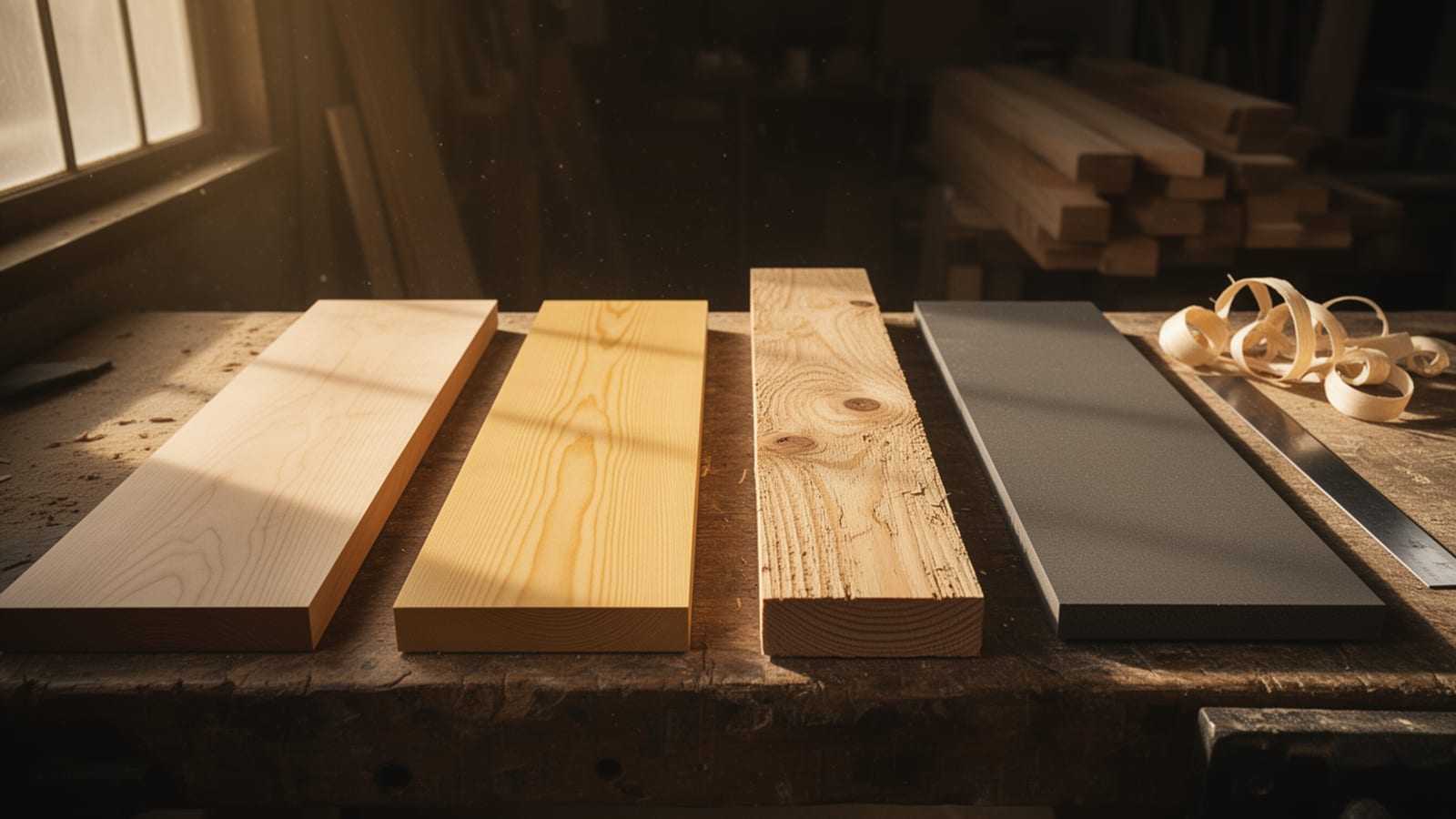
Benchtop Materials Compared: 2x4 SPF vs. Hard Maple vs. Beech vs. MDF, by the Numbers - A step into the workshop.
Stop Wasting Wood
Generate clear cut diagrams instantly with our new Cutlist Optimizer. Plan your cuts to make your next build easier.
The frost is coming out of the shop floor the way it always does in March, a slow surrender that starts at the south wall where the morning sun reaches. I spent part of it dragging a straightedge across my benchtop, thinking about a question that never dies in this craft: what should the top be made of? The forum answers are all conviction and no arithmetic. So let's do the arithmetic.
Hardness, First, Because Dents Are the Honest Test
The one number that measures dent resistance on a like-for-like scale across all four candidates is Janka hardness — the force needed to press a steel ball half its diameter into the side grain. The Wood Database lists hard maple at 1,450 lbf and European beech at 1,450, while Kerfworks puts American beech close behind at 1,300. Douglas fir, the stiffest common framing species, sits at 620 lbf. Less than half. That is the whole argument in a single figure: hammer a chisel-loose mallet blow onto fir and you write a letter onto it; on maple you write a postcard.
SPF — spruce, pine, or fir, depending on what the supplier's bunk holds — runs softer, and the spruces softer still. Kerfworks' species database puts white spruce at 480 lbf and Engelmann spruce at 390. Buy a bundle of 2x4s for a benchtop and you're drawing lots. Some of the sticks will dent like soap.
MDF can't even play this game. It has no published Janka rating — it's a fiber panel, not a species — so any claim about its dent resistance as a number is invention. In my experience it compresses under a sharp corner in a way solid wood does not, and every woodworker who has dropped a holdfast has watched it happen.
What Holds a Screw
Screw-holding sounds mysterious until you see the formula. The Engineering ToolBox publishes the classic withdrawal equation: F = 2850 × SG² × D, in pounds per inch of penetration for seasoned wood in side grain. Specific gravity squared. That squared term is why species matters so much.
Run it: a No. 10 screw (0.190 inch shank) in spruce at SG 0.45 gives roughly 109 lb per inch of penetration. Hard maple, at SG 0.71 by the Wood Database's 12%-moisture figure, works out near 273 lb per inch by the same arithmetic. The fiber matrix of MDF gives decent face withdrawal for its density, but MDF's strength comes from glued fibers, not grain, and its edge screw-holding is widely reported as its weak point. A benchtop lives and dies at its edges: dog holes, holdfasts, the horizontal планка you screw through the apron. Grain holds a screw sideways all day. Fiber crumbs.
The Movement Question — Calculated, Not Measured
Now the part nobody publishes: what happens to flatness over a year. Here I have to be careful with you, because no one has run a proper twelve-month, four-material head-to-head that I could find. What we can do honestly is predict, from published constants, and then describe the measurement you'd run to check the prediction against your own shop.
Wood is hygroscopic. Wagner Meters' EMC table, drawn from the USDA Wood Handbook, puts equilibrium moisture content at 8% for an interior at 40–46% relative humidity, and holds that 6–8% is the acceptable range for interior woodwork. But a heated northern shop in January is a different country — indoor humidity can drop into the 10–20% range in winter — and that swing is exactly what walks a solid-wood top out of flat.
Dr. Eugene Wengert's rule, cited by Wagner, is to dry wood to within two percentage points of your shop's EMC. The dimensional-change arithmetic follows from that. Take a 12-inch-wide flatsawn hard maple top moving from about 9% in a humid summer to 6% in a dry winter — a 3-point swing. Using the Kerfworks movement coefficients, drawn from the USDA Wood Handbook, for hard maple (0.00353 tangential per 1% moisture change), that's 12 × 0.00353 × 3, or roughly 0.13 inches of shrink across the width. Beech's coefficients are higher — American beech runs 0.00431 tangential per 1% by the same source — so the same swing moves a beech top farther, on the order of 0.15 inches. Douglas fir, at 7.3% total tangential shrinkage per the Wood Database, moves less than either hardwood across the same swing, which is the softwood's one quiet virtue here.
Label all of that what it is: calculated, not measured. The measurement protocol is simple enough to run yourself — a good straightedge laid diagonally both ways each season, feeler gauges under the gaps, a date and a hygrometer reading in a shop notebook. Four readings a year, and after twelve months you know your top's temperament better than any chart does.
The Wood Database does carry a "large amount of movement in service" caveat for beech, and I'll note the argument against it fairly: the same page's reader commentary points to a century of moulding planes and European benches in beech that haven't warped. My own read is that a well-seasoned, properly laminated beech top is a fine citizen — but the shrinkage numbers (European beech at 11.7% tangential versus maple's 9.9%) still give maple the edge, and ToolsRadar's comparison reaches the same verdict on stability.
The Machines Deserve Their Due: MDF
I won't pretend otherwise, because MDF earns its place. It comes off the truck dead flat and stays that way, uniformly, with no knots or hard spots to catch a plane. It is the flattest surface in this comparison the day you buy it, and it's cheap and replaceable as a sacrificial top for glue-ups and assembly. Its elastic modulus, though, tells you the trade: MakeItFrom lists 4.0 GPa — about 0.58 million psi — while Kerfworks lists 350,000 psi, and I'll flag honestly that the two sources disagree by a wide margin. Either way it's an order of magnitude below hard maple's 1.83 million psi. MDF sags under its own weight without full support, swells permanently when it gets wet, and cannot be re-planed when it isn't flat anymore. A wooden top can be trued for a century. MDF gets one life, and a dent is forever.
What It Costs, Per Square Foot of Truth
Cost is where the brief goes quiet in spots, and I'd rather tell you that than guess. Hard maple pricing is the best-documented: Wood Vendors listed 4/4–8/4 stock starting at $4.95 per board foot as of September 2025, while ForestSource's 47-dealer aggregated median as of September 2026 was $14 per board foot, with the middle half running $11–15. That spread is grade and figure, and it means you should price your own region before you fall in love with a number.
Beech runs 20–30% cheaper per board foot than maple by ToolsRadar's figures, which averaged $4–6 for beech against $6–9 for maple in 2023 — treat those as dated and regional, but the ratio is useful. For the construction lumber and the 3/4-inch MDF sheets, I checked and the retailer prices wouldn't load, so I'll say only what ToolsRadar's bench budget suggests: $200–400 in lumber for a 4-by-8-foot hardwood top of about 2.5-inch thickness, with kiln-dried stock adding roughly $0.50 per board foot. What you save in dollars you pay in dents.
One seasoning note worth its ink, whatever you choose: air-drying takes roughly a year per inch of thickness, and ToolsRadar recommends kiln-drying to 6–8% and letting the lumber acclimate in the shop two to three weeks before you laminate. A top glued up wet is a top that moves.
So Which One
My judgement, for what it's worth. If you want the top that takes a beating, holds its dogs, and can be planed back to truth by your grandchildren, hard maple is the number-backed choice: it ties beech for hardness, is the more stable of the two hardwoods, and its listed common uses in the Wood Database include workbenches for a reason. Beech buys you nearly the same hardness for less money if you accept a bit more movement and shop around for clean stock. The 2x4 top is a fine rough bench and a fine education in why softwood benches are soft. MDF is the best flattest surface and the worst only surface — put it down over something solid, and treat it as a wear layer, not a legacy.
Then take the straightedge to it four times a year, and write down what you find.