
Slate vs Plywood vs MDF Pool Table Beds: Published Specs, Real Weights, and Leveling Hardware
Slate vs Plywood vs MDF Pool Table Beds: Published Specs, Real Weights, and Leveling Hardware - A step into the workshop.
Stop Wasting Wood
Generate clear cut diagrams instantly with our new Cutlist Optimizer. Plan your cuts to make your next build easier.
The ball breaks dead.
You've seen it happen. A break that should scatter looks fine, but the balls curl on the long rails, or worse, they hop at a seam you can't see. That's not your stroke. That's the bed. And if you're building a pool table in a garage in Texas, the question you have to answer before you cut a single board is what that bed is made of.
The internet is full of confident answers. Most of them are wrong, and a few of them are marketing. Let's go through the three candidates honestly: slate, plywood, and MDF.
What Slate Is Actually Selling You
Slate isn't selling you looks. It's selling you dimensional stability. Billiard slate is a fine-grained, foliated metamorphic rock that splits into flat, uniform sheets, and unlike wood composites it doesn't warp, swell, or shrink with humidity and temperature swings. That's the whole argument, and in a Texas garage that swings from swampy August to a dry blue norther in February, that argument is worth having.
Here's how tight the spec is. Slate of China, a slate manufacturer, publishes a professional flatness tolerance of ≤0.10 to 0.15 mm across the playing surface, inspected with a precision straightedge and feeler gauge. Thickness tolerance runs ±0.30 mm on 45 mm slate and ±0.50 mm on 50 mm slate. A Man & His Cave, an Australian retailer, puts quality slate honed to within 0.1 mm across the entire surface and calls 20 mm the industry minimum for quality home tables. StoneTrades says tournament-grade slate gets machined flat within a few thousandths of an inch. All three hedge the same way: verify per lot, per quarry block, because even stone isn't guaranteed, it's ordered.
On thickness, the numbers split by use. Slate beds run 3/4 inch to 1 inch, and 1 inch three-piece slate is the tournament standard per the Billiard Congress of America, as GameTablesOnline and StoneTrades both describe it. For a home build, 3/4-inch is the standard budget choice.
One more thing people miss: three-piece slate is a matched set, machined from one block with pre-drilled bolt holes and precision-doweled joints. StoneTrades is blunt about it — mix pieces from different production runs and you'll ruin the level playing surface. And a full one-piece slate weighs 200 kg or more, which is a two-man-lift in nobody's language.
Why Plywood and MDF Can't Match It
I'll be straight with you: nothing in the research I found publishes a flatness tolerance for plywood or MDF as a pool table bed, and no source endorses either one as a bare playing surface. But the Composite Panel Association's technical bulletin on dimensional stability tells you what you need to know. Thickness swell and linear expansion in particleboard and MDF are greater than in solid wood, because densified, collapsed fibers swell measurably in high humidity — and the swelling is not fully reversible on re-drying. Read that again. Not reversible.
The bulletin also describes exactly the failure mode a pool table bed invites. Any panel restrained on one face — an overlay, a laminate, cloth stapled to the top — warps concavely toward the restrained side as moisture enters from the bare back. A pool table bed is cloth on one face, air on the other, sitting in a garage. That's the textbook unbalanced construction.
How fast does it show? WPA Pool says MDF flatness degrades noticeably within 2 to 5 years, sometimes within 12 months in humid climates. A Man & His Cave, writing for coastal conditions, gives MDF 3 to 5 years. Nobody disagrees on the direction. LeaguePool adds the kicker: once MDF warps, there's no fixing it, whereas slate can be releveled. That's the difference between maintenance and replacement.
And nobody in this research makes the case for bare plywood as a playing surface either. Not one. I've handled enough cupped sheet goods to have my own suspicions about why, but that's my shop experience talking, not the data. If you're using cheap materials under a playing surface, you've already lost.
The Weight and Price Math
Slate bed weight runs roughly 400 to 800 pounds depending on size and thickness, per LeaguePool; WPA Pool puts a full-size table's slate at 400 to 600. The sources disagree, so treat it as a range and plan your frame and your floor for the heavy end.
Prices, per WPA Pool's US figures: MDF tables run $500 to $1,500, slate tables $1,800 to $10,000 and up, with professional slate installation at $300 to $600. The cost-per-year math is where it gets ugly. WPA Pool's arithmetic: a $2,500 slate table over 30 years is about $83 a year. A $1,000 MDF table replaced every five years is about $200 a year. You're paying less up front and more forever, which is how marketing gets you.
And watch the language. "Slate effect," "slate composite," "synthetic slate," and an unqualified "slate bed" are all terms A Man & His Cave flags as marketing for MDF or hybrid surfaces. A genuine listing says "three-piece slate, 20 mm, honed" plainly. If a table ships flat-pack by courier in one box, it's not slate. Full stop.
The Hardware That Makes Any Bed Playable
Here's the part nobody tells you: the leveling hardware and process matter as much as the material. A dead-flat slate bolted to a twisted frame plays worse than a decent frame that's been shimmed right.
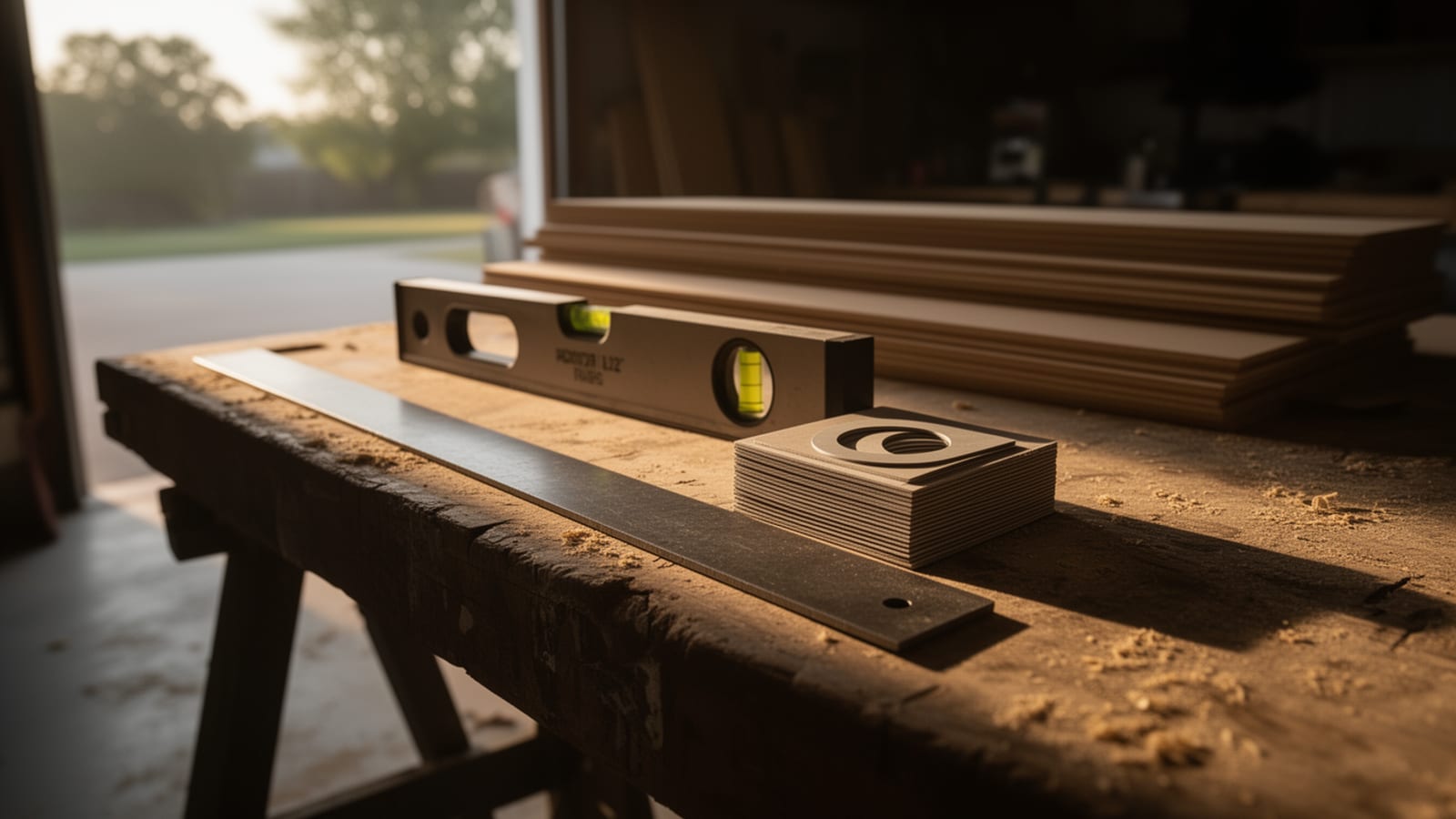
The pro kit, per Pool Table Portfolio: a 12- to 18-inch machinist's level with 0.005-inch-per-foot sensitivity — 0.0005 if you're doing master-level work — a 4-foot level or straightedge for spans, composite or card-stock shims for the slate, rubber or hardwood shims under the legs, and pure beeswax for the seams, applied with a propane torch and scraped flush.
The sequence matters. Level the frame first. Kill the twist and the tilt with leg levelers or shims, working in quarter-turn increments and rechecking after each, the way WPA Pool's leveling guide describes. Then set the slate — center piece first, then head and foot, seams over cross-supports. Here's the step DIYers blow: level the slate with the bolts snug, not torqued. Slate of China's leveling guide is explicit that bolt tension can slightly alter the level, so you finalize after torquing, not before. Tighten screws from the outside in, re-roll a ball across every seam, and if tightening dips a corner, back out and re-shim.
For the DIY build itself, Woodcraftwiz specifies 3/4- to 1-inch plywood or MDF as the sub-support layer under slate — not as the playing surface. Adjustable threaded leg levelers, cross beams sized against mid-span sag, screws through pre-drilled slate holes, and don't overtighten, because you'll crack the slate. Notice what the DIY guides assume: wood carries the slate. Wood doesn't replace it.
The Retrofit Trap
If you own a wood-bed table and you're dreaming of bolting slate into it, the AzBilliards forums have already lived this. One poster who's done these repairs lays out the options: re-true the warped wood top with a jig, risky by hand, or swap in thicker MDF, which gets costly. Another poster names the real problem: you're talking about putting 500 to 600 pounds on a frame built to support 30 to 40. Thread consensus: don't retrofit, buy a used slate bar box — a Valley coin-op was quoted at $400 to $500.
That's the right tool for the job.
The Garage Reality
One last thing, because this is Texas and your table lives next to the lawnmower. WPA Pool's environment guidance: temperature swings and humidity wreck MDF quickly, and while slate handles the conditions better, it still needs climate control to protect the cloth and the wood components. Your bed might be stone. Your rails, your cloth, and your frame aren't.
The Verdict
Slate, three-piece, 3/4-inch minimum for a home build, on a frame you've leveled with the bolts snug. Plywood and MDF are sub-support materials, not playing surfaces, and the panel industry's own technical bulletin explains exactly why: they swell, they don't swell back, and they warp toward whatever's stapled to their face. If you can't swing slate new, buy a used slate bar box before you bolt 600 pounds of stone onto a frame built for 40. The bed is the table. Don't cheap out on it.