
Outdoor Wood Finish at 24 Months: DuroGrit, Osmo, Penetrating Oils, and Film Compared
Outdoor Wood Finish at 24 Months: DuroGrit, Osmo, Penetrating Oils, and Film Compared - A step into the workshop.
Stop Wasting Wood
Generate clear cut diagrams instantly with our new Cutlist Optimizer. Plan your cuts to make your next build easier.
Rubio, Osmo, Penetrating Oil, and Film at 24 Months
Four finish families keep coming up in questions about outdoor furniture: Rubio's DuroGrit, Osmo's UV-Protection Oil, penetrating oils, and film finishes like spar varnish. First summer tells you how a finish applies. Second summer tells you what it's made of. So I went looking for what actually happened at the 24-month mark to each of them.
Here's the honest headline before we get into anything: there is no independent, instrumented 24-month comparison of these four sitting anywhere in public. Nobody's publishing it. What exists is one well-documented piece of furniture in Missouri, one catastrophic failure report from a pro in the UK, and a few multi-year retrospectives from people who actually leave furniture outside. That's the whole evidence base. I'll tell you what it says, and I'll tell you where it runs out.
The Rubio That Survived Missouri
The best long-term data on DuroGrit comes from Marc Spagnuolo, The Wood Whisperer, who finished an outdoor coffee table in June 2024 and left it on an exposed Missouri patio. Full rain, humidity swings, direct sun. That's a fair proxy for a lot of the country, though it's not a fair proxy for a July parking lot in Austin.
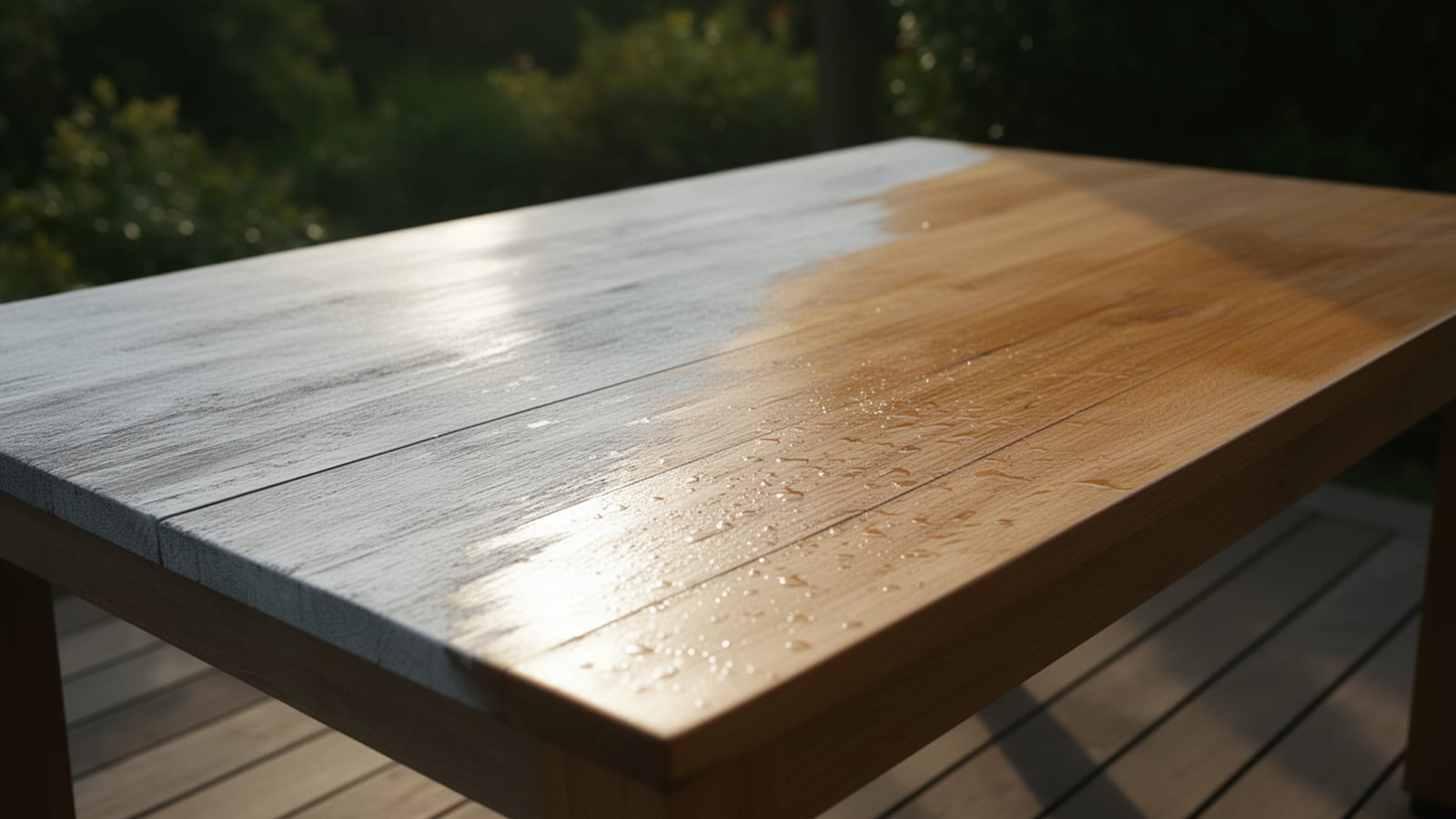
His update a few years in, from May 2026: the finish is fading in some areas, it could use a new coat, and there's no flaking or peeling. Read that again, because the failure mode matters more than the fading. A hardwax-oil-type finish that fades is a finish asking for a maintenance coat. A finish that peels is a finish asking for a sander and a bad afternoon. At the one-year mark he'd reported a little wear in some areas but overall it was holding up, and he noted that getting two years out of an exterior finish before reapplication is a pretty good result. I'd agree. Two years before a wipe-on recoat is a schedule you can live with.
The catch with DuroGrit is that it's a one-layer product, and Rubio says so themselves: a second coat may not adhere and can scratch off easily, except on very grey or weathered wood, where a diluted second coat may be needed. That's a strange property if you're used to building film thickness coat by coat. You get one shot at application. Rubio lists it at 80 to 150 square feet per liter, a 3-day cure at 68 degrees, 0% VOC, at $81.99 per liter or $188.99 for 2.5 liters from the Rubio Monocoat USA store. The 2.5 liter jug covers 200 to 375 square feet, so for a table or a set of chairs you're not spending much either way.
One limit worth flagging: Spagnuolo declined to endorse it for cladding. This is furniture-only evidence. Don't stretch it.
The Osmo Trap: Read the Label
Now the one that burned people. Osmo makes great interior hardwax oil, and a lot of folks assume the exterior version is the same story. It isn't, in two ways.
First, Osmo's exterior product is UV-Protection Oil, a separate line, and Osmo's own labeling restricts it to vertical surfaces. Doors, windows, shutters, cladding, fences, pergolas. Tools for Working Wood's listing states plainly it's not recommended for flat exterior surfaces like decking, and that for tables and chairs where rainwater ponds, Osmo points you to their Decking Oil instead. The much-advertised "12x UV protection" is conditioned on vertical orientation after two coats, per Osmo's product information sheet. The 12x number was never a tabletop claim.
Second, the field data. A UK finisher reported on the Festool Owners Group forum in November 2022 that after Osmo reformulated 420 Clear to meet European solvent rules, it failed catastrophically on horizontal surfaces as soon as it got wet. His example: a set of kiln-dried oak driveway gates that failed within 18 months. That one report cost him seven complete strip-and-refinish jobs in six months. Osmo's remedy, per his account, was a refund of the can. That's one finisher's report and I'm attributing it as such, not as Osmo's official position. But the economics are the lesson regardless of whose finish failed: a film-style failure on horizontal exterior work means stripping to bare wood, every time, and stripping is the most expensive word in finishing.
Specs and pricing, from Osmo USA and Tools for Working Wood: two coats at roughly 172 square feet per liter per coat, about 12 hours dry time, 410 Clear at $42.99 for 0.75 liters or $135.99 for 2.5 liters. That's real money for a product that tells you, on the can, not to use it where you probably wanted to use it.
Penetrating Oils: Fail Gracefully or Don't Fail
Spagnuolo's multi-year furniture retrospective, "All Exterior Finishes Fail," is the most useful document in this whole space, and its central finding is blunt: UV, not moisture, is what kills finishes. His words were that no matter what he used, if direct extended UV exposure was involved, the finish failed quickly. Every finish.
His second finding is the one that should drive your buying decision. Non-film penetrating finishes fail gracefully. They fade, they wear, they take a cleaning and a recoat. Film finishes fail by peeling and bubbling, and they take a full strip-down. That's not a quality difference, it's a structural one. A film sitting on top of the wood has nowhere to go but off.
One anecdote from his comment thread that I'll pass along clearly attributed: a commenter in Carlsbad, California, with a covered-but-open outdoor room, watched General Finishes Exterior 450 die in about a year under UV, while five coats of Waterlox Original, a tung-oil-based finish, over bare wood still looked good almost five years later. Recoatable with minimal prep, but it wants a 7-day cure. One data point, sea air, partial shade. Treat it that way.
Film Finishes: Pay Me Now or Pay Me Later
Film finishes aren't frauds. A CPES-plus-varnish system on a piece that lives in limited sun can last a long time, and a 2025 commenter on that same Festool thread reports good results with two coats of Smith's CPES followed by Sikkens, now sold as PPG ProLuxe Door and Window Wood Finish, touching up heavy-UV areas every two to three years. Notably, that system fails by wearing away rather than flaking, which is the graceful end you want from a film.
But Spagnuolo's own history is the warning label. A CPES and Epifanes combination he once called bulletproof became an ugly mess when he neglected it in full UV, and he blames the skipped maintenance, not the product. His rule, and it's a good one: if you don't plan to do maintenance, don't apply a film finish unless the piece will live in the shade.
There's also an uncomfortable truth hiding in the forum threads. The UV absorbers in clear finishes degrade as they work. They're sacrificial. Even a well-maintained clear film eventually needs recoating or stripping, which is why heavier pigmentation holds up better outdoors. Put in enough color and you've made paint, and paint is one of the best exterior wood finishes there is. Nobody wants to hear that. It's still true.
Species and Design Beat Finish Choice
Two findings from the same retrospective that have nothing to do with which can you buy. Soft western red cedar caused repeated film-finish failures on his table because every dent and scratch became a failure point, while the same class of finish held fine on harder sapele. If you're building outdoor furniture out of a wood that dents when you look at it, use a non-film finish. Full stop.
And his big table with the solid top failed repeatedly where rain and snow pooled, while slatted tops that shed water and dry out lived longer. He also found epoxy foot pads genuinely work against end-grain wicking. A half hour of design thinking beat every can on the shelf.
What I'd Do
If you're coating a horizontal outdoor surface, the evidence points one direction: a penetrating, non-film finish you can clean and recoat, on a hard species, on a design that drains. DuroGrit has the best documented two-year furniture track record I can find, and its failure mode at 24 months was fading, not peeling. Keep Osmo's UV-Protection Oil on vertical work where it belongs. Reserve film finishes for pieces in shade or for people who genuinely enjoy maintenance schedules. And if a manufacturer's own label says "not for flat surfaces," believe them the first time.
What's missing is the test nobody's published: same bench, four finishes, three years, measured. Until someone does, you're choosing based on failure mode and recoat economics, not laboratory numbers. Given what the second summer does out here, that's not a bad way to choose.