
Diode Laser, Rotary, or Desktop CNC: What Personalizing Woodworking Gifts Really Costs
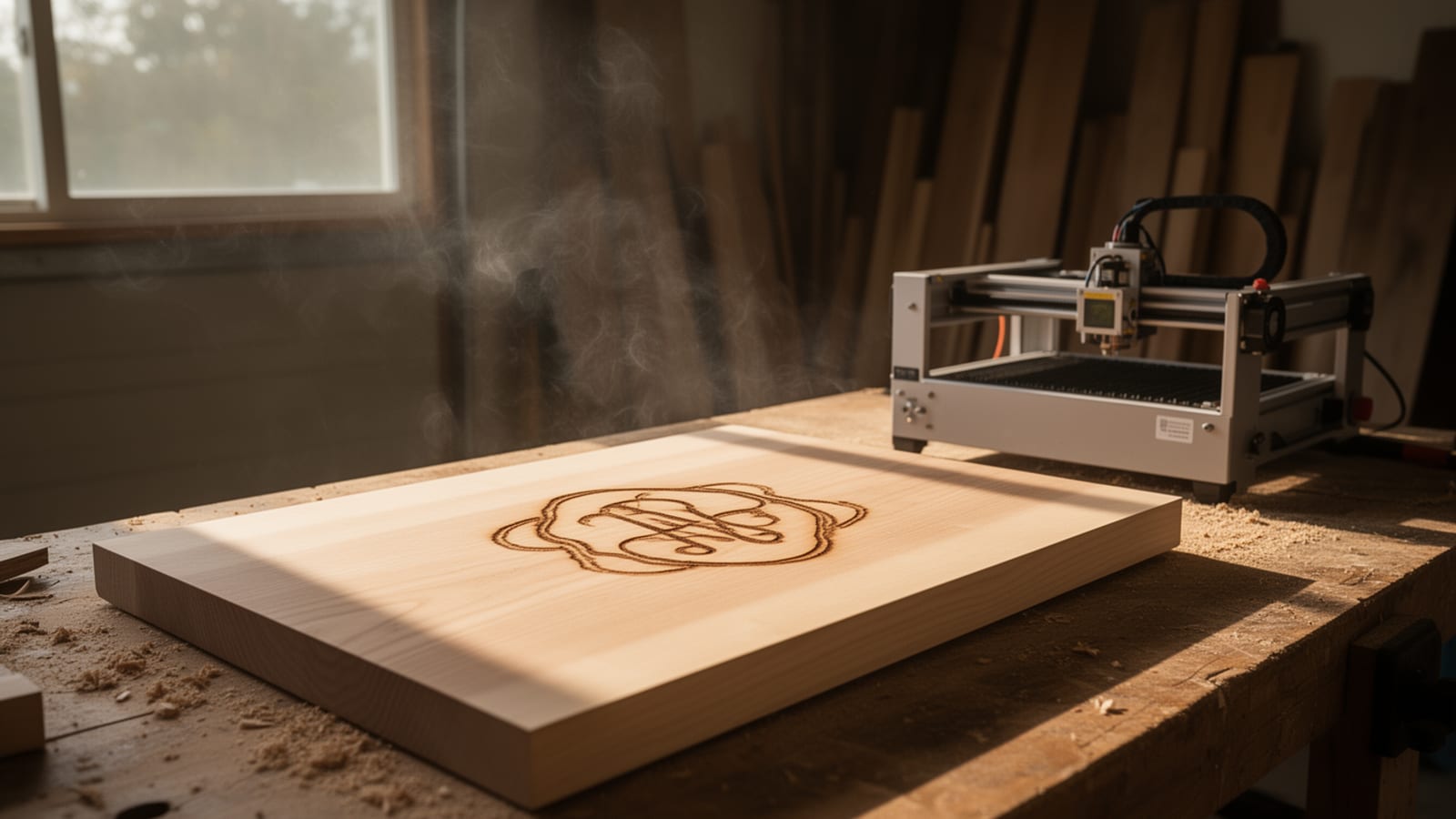
Diode Laser, Rotary, or Desktop CNC: What Personalizing Woodworking Gifts Really Costs - A step into the workshop.
Stop Wasting Wood
Generate clear cut diagrams instantly with our new Cutlist Optimizer. Plan your cuts to make your next build easier.
We've all been there. The cutting board is done, the finish is cured, and it looks good. Then someone asks the question that turns a nice project into a keepsake: "Are you going to put their names on it?" Personalizing is where a gift stops being wood and starts being theirs. The catch is that there are three very different machines hobbyists use to do it, and they are not interchangeable. Here's how they compare on cost, speed, and the materials they simply can't touch.
The Three Tools, in One Paragraph Each
A desktop CNC router cuts by physically removing material with a spinning bit. It can do 2D profiles and real 3D carving. A diode laser engraver uses focused light to burn or melt the surface without ever touching the wood. And a rotary attachment isn't a third machine at all; it's an accessory for a laser that grips a tumbler or glass in rollers and rotates it under the beam.
The shorthand I keep coming back to comes from TwoTrees, who put it directly: for a cutting-board business, the CNC surfaces boards, cuts juice grooves, shapes handles, and adds inlays, while a diode laser "cannot remove that volume of material but can engrave logos, names, and intricate designs with sharp, high-contrast detail on finished boards." In other words, the CNC makes the board and decorates it structurally. The laser signs it.
What Each One Costs to Start
The entry point for CNC is lower than most people expect. SainSmart lists the Genmitsu 3018-PRO desktop router kit at $159 on sale, $199 regular, with a working area of 11.8 by 7.1 inches and 1.8 inches of depth. It cuts wood, plastics, acrylics, PVC, PCBs, and even soft aluminum.
On the laser side, TwoTrees positions its TTS-55 Pro and TS2 20W as beginner machines, and xTool's D1 Pro line spans 10W, 20W, and 40W modules. I can't give you a verified complete-machine price for the xTool units, and I'd rather say that than guess.
The rotary is the surprise line item. Swing Design lists xTool's RA2 Pro 4-in-1 rotary bundle at $298.99, down from $369.99. That's a real chunk of money on top of the laser itself, and whether it's worth it depends entirely on whether tumblers are in your future.
Ongoing costs differ too, and this is the part nobody mentions at purchase time. TwoTrees notes that CNCs consume bits, collets, spoilboards, and dust collection, while lasers go through lenses, protective windows, and fans. With the laser you also eventually replace the diode itself. xTool's FAQ puts diode lifespan at roughly 10,000 hours, while HeatSign claims 25,000 to 50,000 hours for diodes kept cool and clean. Those numbers disagree, and since both come from vendors with products to sell, I'd plan around the lower figure and treat anything above it as a bonus.
Speed: Where the Laser Runs Away With It
The CNC is slower per job, full stop. It removes material layer by layer, and each job carries setup overhead: spoilboard surfacing, bit selection, simulation. TwoTrees points out that a small batch of laser-engraved keychains or coasters can be nested and engraved in minutes, and there's an honest gap in the research here: I found no independent engraving-time-per-square-inch benchmark for any of these tools. The one hard number that exists is xTool's own timed test, cutting a square in 5mm basswood at 100% power: the 20W module finished in 1 minute 1 second versus 2 minutes 20 seconds for the 10W module. That's a single test from the manufacturer, but it tells you the wattage tier matters as much as the machine choice.
On wattage, TwoTrees' settings guide gives useful ranges. A 5W diode engraves wood, leather, and paper and only light-cuts 2 to 3mm of softwood across multiple passes. A 10W handles 3 to 5mm plywood or acrylic with passes. A 20W module can cut up to roughly 8 to 10mm of wood with passes. xTool's own data says its 20W module cuts 10mm basswood plywood and 8mm solid wood in a single pass, handles basswood, pine, walnut, and Manchurian ash in one pass, and needs 2 to 3 passes for denser beech, cherry, and bamboo. If your gift list runs to cherry keepsake boxes, plan on the extra passes.
Where Each Tool Physically Can't Go
This is the section I wish someone had written before my first "why won't it mark this?" afternoon.
The diode laser cannot cut metal. It surface-marks only. Bare aluminum won't mark at all without coatings; anodized or coated metal marks well at low power and high speed, per TwoTrees. On stainless steel you get a shallow mark, not a groove, and HeatSign notes that high-contrast results require a marking spray. Their example settings: 600mm per minute at 70% power for 10 passes gives a cleaner mark than 200mm per minute at 80% power for 4 passes. One safety note I won't soften: engraving stainless can put nickel and chromium particles in the air, so ventilation or filtration is required. Our earlier fume-extraction article covers the setup; read it before your first steel job.
Clear acrylic is a laser dead end. The 450nm wavelength passes straight through it, so cutting is unreliable. Engrave painted or blackened surfaces, or use opaque cast acrylic instead.
Thick stock beyond about 10mm of wood is out, even with passes. And the laser only ablates a shallow surface layer, so it physically cannot machine pockets or inlay. A contrasting-wood monogram glued into a board? That's CNC work.
The CNC has its own walls. TwoTrees rates it poorly on leather and fabric, which fray, and impractical on paper and cardboard, which tear and fight fixturing. Steel is not suitable at hobby scale for either machine type. And for all its strength on carving and relief, the CNC is the wrong tool for fine photo or grayscale engraving; that dot-based detail is squarely the laser's domain in TwoTrees' decision matrix.
Curved stock defeats both machines without help. Neither a flat laser bed nor a 3-axis CNC can engrave a curved surface. That's what the rotary is for: the object rotates under the beam line by line. Worth knowing before you buy, the Genmitsu 3018-PRO does not support a 4th axis; only the 3018 REX does, per SainSmart's specs. And be patient with rotary work. A community thread on r/Laserengraving describes it as much slower than flat-bed engraving. That's anecdote, not measurement, but it matches the physics of spinning a tumbler under a beam one line at a time.
Cutting Boards: The Food-Safety Wrinkle
If you're personalizing a board someone will actually cut on, slow down here. Engraving ablates and vaporizes the wood surface, creating grooves that can harbor bacteria if left unsealed, and it can leave loose charred particles. NEJE recommends keeping engravings shallow on hardwoods and sealing afterward, naming food-grade mineral oil and beeswax, food-grade varnish, or FDA-approved epoxy, reapplied every 3 to 6 months. Two cautions from me: NEJE is a laser vendor with a product to sell, so treat that resealing interval as vendor guidance rather than regulation, and their suggestion of alder and cherry as food-friendly engraving woods is their call, not a standard. Our cutting-board article already covers the FDA Food Code's species testing, so I'll point you there rather than repeat it.
One more thing that circulates as community wisdom and holds up: don't laser-engrave a board that's already been oiled. Burning oil is bad for the finish and worse for anyone eating off it. Engrave first, oil after.
So Which One Belongs in Your Shop?
Here's my honest read for the time-poor woodworker. If you want to add names, logos, and photo detail to gifts you're already building, a 20W-class diode laser is the fastest path from "finished project" to "finished gift," with the fewest new skills between you and the result. If you want to build the gift itself, with juice grooves, carved relief, or genuine inlay, the CNC earns its steeper learning curve, and SainSmart's $159 kit is a gentle way in. If tumblers are your love language, budget the $299 rotary and accept the slow line-by-line pace as the price of wrapping a beam around a curve.
My own plan is the unglamorous one: the CNC shapes the gift, the laser signs it, and both earn their bench space one wedding season at a time.