
Benchtop Jointer vs. Table Saw Jigs and Shooting Boards: What $275 Actually Buys
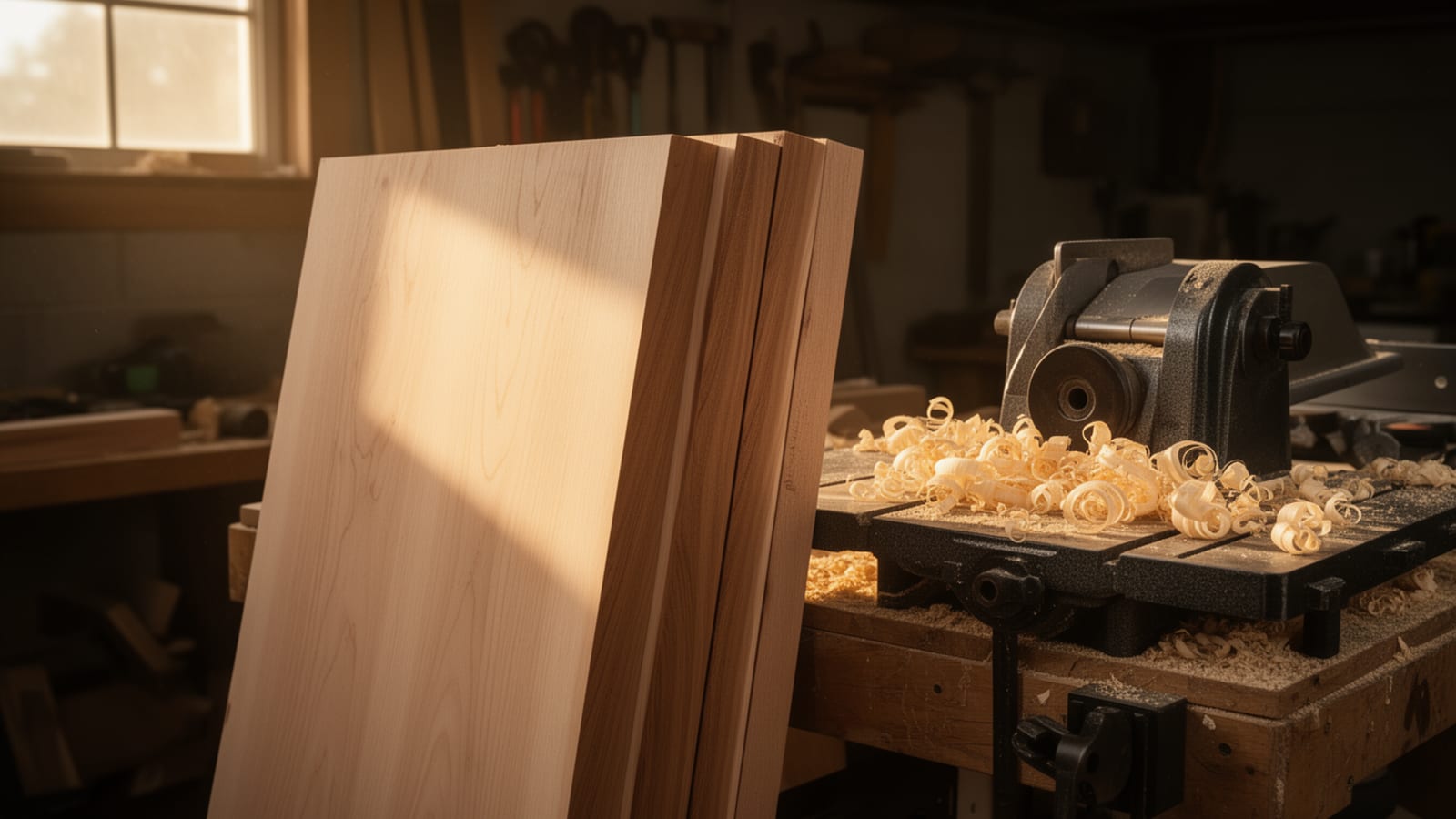
Benchtop Jointer vs. Table Saw Jigs and Shooting Boards: What $275 Actually Buys - A step into the workshop.
Stop Wasting Wood
Generate clear cut diagrams instantly with our new Cutlist Optimizer. Plan your cuts to make your next build easier.
Yo, let me tell you a story. My buddy Dante calls me last month, all excited. He found a stack of roughsawn cherry leaning on a brownstone stoop on St. Mark's, free, just sitting there. He hauls it home on the subway like a madman. Two-by-six, eight feet long, gorgeous grain.
Then he tries to glue four of those boards edge to edge and discovers the truth every one of us learns the hard way: roughsawn lumber is not straight, and a table saw cannot make it straight. The table saw needs a straight reference edge to even work. His glue-ups open up like the subway doors at rush hour.
So now he wants a jointer. And like everybody in Brooklyn with a second bedroom pretending to be a shop, he's looking at benchtop jointers, the $275-to-$600 class. The question he asked me is the question I'm going to answer with actual numbers: what does that money actually buy you over the free alternatives? Because I've done the table-saw jig thing, and I've done the hand-plane thing, and neither one costs $300.
Why the Benchtop Exists At All
Here's the market reality first. WOOD magazine ran a 12-model benchtop jointer test in May 2023, and their lead-in tells you everything: price creep has pushed even value-priced 6-inch floor-standing jointers from the $500 range to over $1,000, which is why benchtop models selling for as little as $250 became the entry point. Their test machines ranged from $250 to $1,100, weighed 35 to 70 pounds, and took up about 20 by 30 inches of floor space.
Twenty by thirty inches. For my shop, that's not a spec, that's the difference between owning one and not.
And here's the part I love: the segment has converged so hard you can barely tell them apart. WOOD's own words are that "many of these machines are nearly identical." Look at the current prices I checked in February 2026. The WEN JT630H 6-inch spiral jointer is $273.83 at Home Depot and $349.42 direct from WEN, a spread worth knowing about before you click buy. The Cutech 40160HB is $319.99 direct. The Grizzly G0946 is $375 plus $29.95 shipping. The Wahuda 50160CC-WHD is $499.99 with free shipping. Three of those four sit in a $275-to-$375 band, all with 30-inch-class tables and spiral-style heads. You're not shopping for a different machine. You're shopping for a different warranty and a different shipping bill.
What WOOD Actually Measured
WOOD's test is the real data we have on this class, so let's walk through it.
Power test: they face-jointed 6-inch-wide, 3-foot hard maple boards taking 1/16 inch per pass and timed it. The Grizzly G0946 was fastest at 1:03. Six other models finished in 1:12 or less. The Delta 37-071 was slowest at 2:18. That spread tells you the middle of this market is genuinely usable. A minute and change to face-joint a three-foot board of a dense hardwood is real work, not toy work.
The walls show up at full depth. At the maximum 1/8-inch cut, every 6-inch model in WOOD's test needed a much slower feed rate, some bogged down, and the Delta couldn't finish the cut at all. WOOD's advice, which I co-sign: keep full-width cuts shallow and save full-depth passes for narrow boards and edge work. Edge jointing, which is what you're doing for glue-ups anyway, is the easy job. That's actually good news for Dante.
Cut quality: they face-jointed walnut at 1/32 inch and chalked the surface to expose tooling marks. Four machines produced the cleanest surfaces: the Grizzly G0945, Rikon 20-800H, Shop Fox W1876, and Wen JT3062. The Delta's two-knife cutterhead left consistent scallops and chatter needing significant sanding. Sanding chatter out of a face is hours of your life you don't get back, so this test matters.
Snipe: only two machines in the whole test produced measurable snipe, the Delta and the Shop Fox, at 0.03 inch deep. Visible, but WOOD says it takes only moderate effort to fix. Here's the catch you should know before buying: benchtop outfeed tables in the test can't be raised or lowered, so on straight-knife machines you fix snipe by lowering the knives, and on insert-head machines there's no adjustment at all. Buy the head you can live with.
Cutter economics, because you'll pay this eventually: the five straight-knife machines in WOOD's test all share one cutterhead design, and replacement HSS knives run $10 to $44 a pair. WOOD also notes that long-wearing carbide cutters are rare on benchtop machines and steel dulls faster. That's why I steer people toward the spiral-head models. Cutech specs its 12 two-sided tungsten carbide inserts as machined to 0.0007-inch tolerance, though their claims about insert life beating HSS by 50 percent are manufacturer marketing, not independent measurement. Treat that number as a commercial, not a lab result.
One more WOOD finding that matters in a small shop: all 12 machines have paired infeed and outfeed tables between 13 and 15 inches long, and those short tables make it difficult to work boards longer than 5 or 6 feet without support stands. The 8-inch models add extensions good to 8 feet. If you're jointing long shelving stock, plan for roller stands or a helper.
If your budget stretches past the band, there's a ceiling worth knowing: the Rikon 20-800HSP 8-inch helical benchtop is $749.99 direct from Rikon and $659 at Rockler (regular $859), with 16 two-sided carbide inserts.
What the Free Alternatives Actually Do
Now the honest part. I've jointed edges on the table saw for years, riding a registered straight edge against the fence with featherboards and push blocks. It works. The technique is real and documented, though the best sources out there are community forums and an Instructables tutorial, so nobody's published rigorous accuracy numbers on it. You're trusting your fence and your setup.
But here's the limit, and WOOD says it plainly: a jointer is the best and fastest way to flatten the face of a board and square an edge to that flat face. A table-saw jointing jig only straightens edges. It never flattens faces. It never removes twist. That cherry on Dante's stoop? Cupped, twisted, rough. No table saw jig fixes that. The benchtop jointer, even a $274 one, plus his planer turns it into project stock. The jig does not.
The hand-plane route is more interesting than people think. A shooting board does three things: shoots long grain, squares end grain, and trues mitres. You can build a functional one in under 20 minutes from 1/4-inch and 3/4-inch plywood plus 1x1 stock, per the Woodworkers Institute, and they're blunt about the one thing that matters: the accuracy of the 90-degree planing stop is critical, or the board is worthless. You also need a blade ground and honed perfectly square, not cambered, in your sharpest tight-mouthed plane. The classic pick is a bevel-up low-angle like the Stanley No. 60½.
And there's one thing the shooting board does that neither a jointer nor a table saw can do: adjust a board's length by a single shaving, a few thousandths of an inch at a time. Shot joints are clean enough for rub joints, glued without clamps. For fitting a shelf into a dado or sneaking up on a final length, the shooting board wins outright. No benchtop jointer in any price band does that.
What the Money Actually Fixes
So here's my judgement, Dante.
The $275-to-$600 benchtop jointer fixes exactly two problems the free methods can't: flattening faces and removing twist. That's it. That's the whole purchase. Edge jointing, your table saw jig handles fine with good setup. End grain and length fitting, your shooting board and a sharp plane do it better than any machine.
But face flattening and twist are not small problems. They're the gate between roughsawn stoop-salvage and actual furniture. If you're buying hardwood at retail, milled and square, skip the jointer and build the shooting board this weekend. If you're pulling rough lumber off stoops and Craigslist like the scrappy menace you are, the jointer is the missing machine, and the WEN at Home Depot's $273.83, or the Cutech at $319.99 if you want carbide inserts and a 3-year warranty, is the buy. In WOOD's test, every 6-inch machine choked a little on full-depth full-width cuts and every one had short tables needing support stands past 6 feet. And check the fence for square the day it arrives, because setup variance on these machines is a real thing people report in both directions.
Your millimeter of truth, measured the only way that counts: glue a test panel with each method and see which line disappears. I know which one Dante's betting on.